The Different Types of Fire Extinguishers and Their Uses (2026 Guide)
Published by FireTron Fire Protection Experts | Updated for 2026 Compliance
When a fire breaks out in your commercial facility, having a fire extinguisher nearby is only half the battle. The other half is ensuring you have the correct type of extinguisher for the specific hazard at hand. Using the wrong extinguishing agent can be ineffective or, in some cases, catastrophic. At FireTron, we have spent over 30 years providing top-tier fire protection services across Texas, and we know that education is the first line of defense.
Many business owners frequently search online asking what are the different types of fire extinguishers. However, modern fire safety standards actually recognize five primary classifications of fires and each of those types of fire require a specific type of suppression agent. In this comprehensive guide, we will break down the differences between extinguisher types, outline the strict legal requirements for their selection and placement, inform you on how to choose which is the best type of extinguisher for your need, provide a brief overview of how to keep them serviced and compliant, and answer commonly asked questions.
Differences Between Extinguisher Types
Fire extinguishers are not one-size-fits-all devices. Different hazards require different suppression agents, and each type of fire extinguisher is meticulously engineered to combat specific fuel sources. Understanding these classifications is the foundation of a robust fire protection system.
Here a detailed look at the primary fire extinguisher types you will encounter in commercial and industrial settings.
CO2 vs. Clean Agent Fire Extinguishers
When protecting sensitive electrical equipment, facility managers often weigh Carbon Dioxide (CO2) against Clean Agent fire extinguishers. While both are electrically non-conductive and leave no residue, Clean Agent fire extinguishers (such as those using Halotron I or FE-36) offer superior versatility and safety in occupied spaces. CO2 extinguishers displace oxygen to smother a fire, which can pose a suffocation risk in confined areas, and their extremely cold discharge can cause thermal shock to delicate electronics. In contrast, Clean Agents interrupt the chemical reaction of the fire itself, are safe for human exposure, do not cause thermal shock, and often boast a broader rating (such as Class A, B, and C), making them the premier choice for data centers, server rooms, and telecommunication facilities.
Water and Water Mist (Class A): Ordinary Combustibles
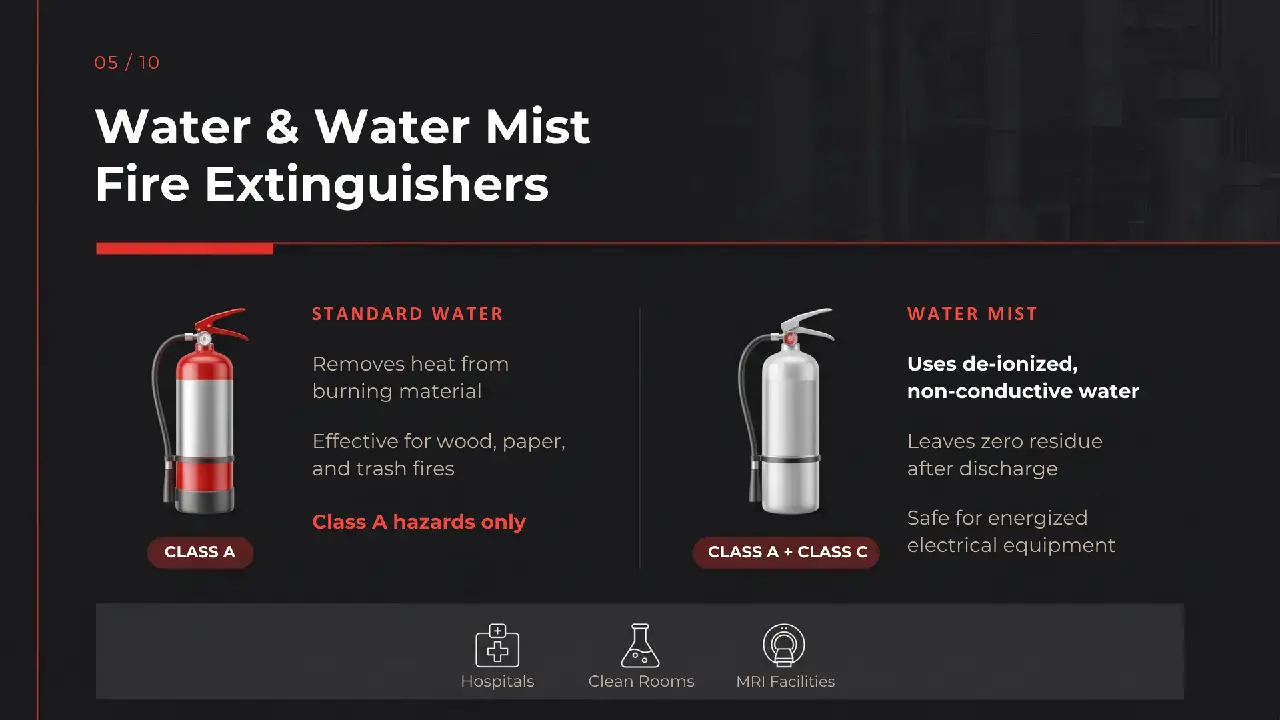
Class A fires involve common materials such as wood, paper, cloth, rubber, trash, and plastics. These are the most common types of fires in office buildings and retail spaces. Extinguishers designed for Class A fires typically use water or a specialized foam to remove the heat element from the fire triangle. You will often see these units in hallways and general office areas.
Modern Water Mist Extinguishers (such as the Amerex Model B272) use de-ionized water discharged as a fine mist. This mist is non-conductive, which makes it safe to use for Class C electrical fires as it leaves no residue. These specific Water Mist Extinguishers are highly recommended for hospitals, clean rooms, MRI facilities, and areas with lithium-ion battery risks.
Dry Chemicals (Class B): Flammable Liquids and Gases
Class B fires are fueled by flammable liquids like gasoline, oil, paint, and solvents, as well as flammable gases. These hazards are prevalent in workshops, garages, and manufacturing facilities. Class B extinguishers utilize carbon dioxide (CO2) or dry chemicals to smother the fire and cut off its oxygen supply. It is crucial never to use a water-based extinguisher on a Class B fire, as water can spread the flammable liquid and expand the hazard.
Clean Agent (Class C): Energized Electrical Equipment
Class C fires involve energized electrical equipment such as wiring, server racks, breaker panels, and appliances. If you are looking for an electrical fire extinguisher, you must select a unit that uses non-conductive agents. The best fire extinguisher for electrical fires is typically a Carbon Dioxide (CO2) or Clean Agent extinguisher. These agents safely smother the flames without conducting electricity back to the user and leave no damaging residue on sensitive electronic equipment. Once the equipment is completely de-energized, the fire technically transitions into a Class A or B fire, but non-conductive agents remain the safest initial response.
Dry Powder (Class D): Combustible Metals
Class D fires are unique and involve combustible metals like magnesium, titanium, sodium, and lithium. These fires burn at incredibly high temperatures and are typically found in specialized laboratories, machine shops, and industrial manufacturing plants. Class D fires require a specific sodium chloride-based dry powder extinguisher that absorbs heat and forms a crust over the burning metal, cutting off the oxygen supply and dissipating heat. Standard extinguishing agents can cause violent, explosive reactions when applied to burning metals.
Wet Chemical (Class K): Cooking Oils and Fats
Class K fires involve combustible cooking fires, such as vegetable oils, animal fats, and greases. These fires burn at much higher temperatures than standard flammable liquids. A wet chemical extinguisher is the mandatory fire extinguisher for commercial kitchen environments.
Class K extinguishers use a potassium acetate-based agent. When discharged onto burning cooking oil, the agent creates a soapy foam blanket (a process called saponification) that seals the surface, prevents oxygen from reaching the fire, and cools the liquid below its ignition point.
Multi-Purpose Extinguishers (ABC Dry Chemical)
For general commercial office buildings, retail stores, and warehouse spaces, the most common unit installed is the ABC Dry Chemical extinguisher. As the name suggests, these units are rated to handle Class A, Class B, and Class C fires. They use a specially fluidized and siliconized mono ammonium phosphate powder that melts and flows to smother the fire. It chemically insulates Class A fires by melting at approximately 350 degrees Fahrenheit and coats the surface to which it is applied. It also smothers and breaks the chain reaction of Class B fires and is non-conductive for Class C fires.
While highly versatile, the powder can be corrosive to sensitive electronics, which is why dedicated clean agent units are still preferred for server rooms.
Legal Requirements for Selection and Placement of Fire Extinguishers
Selecting the right extinguisher is only the first step. The Occupational Safety and Health Administration (OSHA) and the National Fire Protection Association (NFPA) strictly regulate how these devices must be selected, distributed, and mounted within your facility.
Commercial Fire Extinguisher Requirements
Understanding commercial fire extinguisher requirements is critical for passing fire marshal inspections and avoiding hefty OSHA fines. Under OSHA standard 29 CFR 1910.157, employers are legally required to provide portable fire extinguishers that are readily accessible to employees without subjecting them to possible injury. The selection of these extinguishers must directly match the anticipated fire hazards in that specific area.
Travel Distance and Spacing Rules
OSHA and NFPA 10 dictate maximum travel distances to ensure employees can reach an extinguisher quickly during an emergency. Travel distance is measured by the actual walking path around obstacles, not a straight line through walls.
- Class A Hazards: The maximum travel distance to a Class A extinguisher is 75 feet.
- Class B Hazards: The maximum travel distance to a Class B extinguisher is 50 feet.
- Class K Hazards: In commercial kitchens, a Class K extinguisher must be located within 30 feet of the cooking equipment.
Mounting Height Regulations
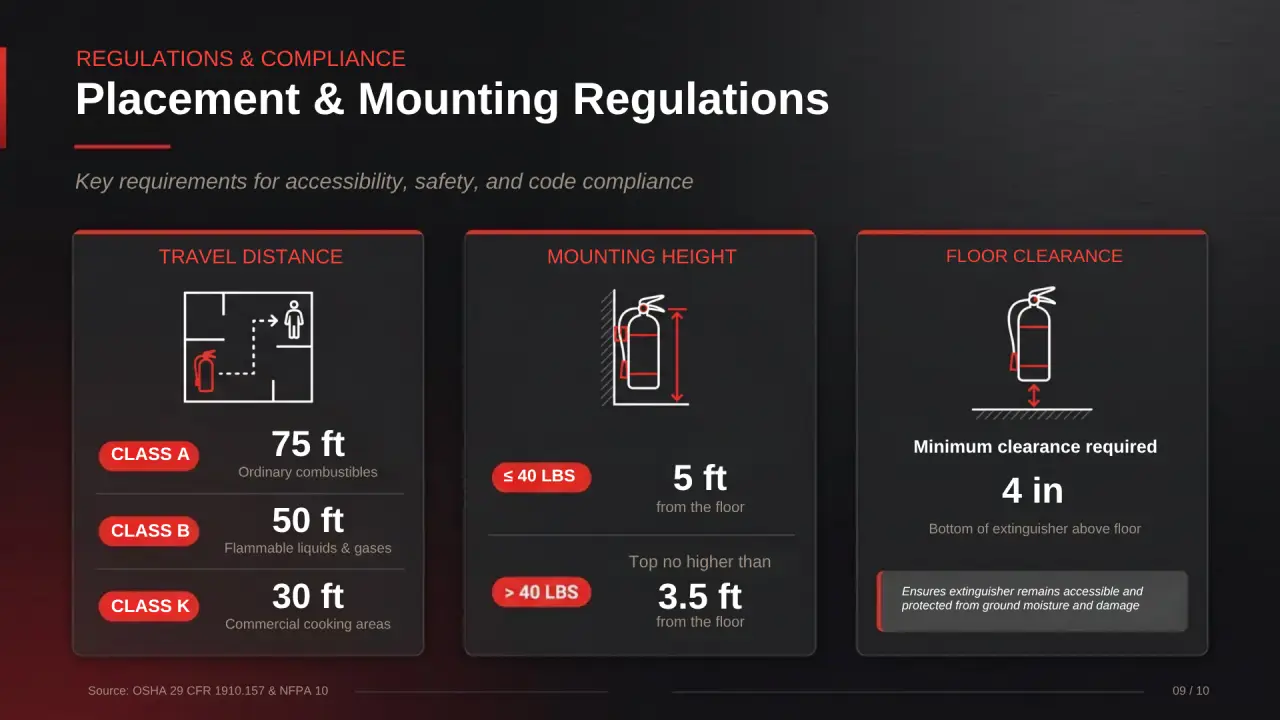
Improper mounting height is one of the most frequently cited violations during safety audits. NFPA 10 and OSHA require specific mounting heights based on the weight of the unit to ensure they can be safely lifted by any employee.
- Units weighing 40 pounds or less: The top of the extinguisher must be no higher than 5 feet from the floor.
- Units weighing more than 40 pounds: The top of the extinguisher must be no higher than 3.5 feet from the floor.
- Floor Clearance: In all cases, the bottom of the extinguisher must be at least 4 inches above the floor to protect it from moisture, cleaning chemicals, and physical damage.
Inspection and Disposal
2026 NFPA 10 Update: The 2026 edition of NFPA 10 has introduced new performance-based inspection programs and strict disposal requirements for condemned non-DOT cylinders.
- If an extinguisher shows signs of pitting, fire damage, or has been repaired by welding, it must be permanently removed from service and disposed of according to these new environmental and safety guidelines.
How to Choose the Right Fire Extinguisher for Specific Needs
Selecting the right equipment requires a thorough hazard assessment of your facility. Here is a practical guide to help you choose:
For Offices and General Commercial Buildings
Standard office spaces, retail stores, and classrooms primarily face Class A (paper, wood) and basic Class C (plugged-in computers, breakroom appliances) hazards. The most cost-effective and reliable choice is the ABC Dry Chemical extinguisher. It provides broad coverage for the most common workplace emergencies.
For Commercial Kitchens and Restaurants
Restaurant owners frequently search for “kitchen hood fire suppression system price” and “restaurant fire extinguisher” [1]. For any area with deep fryers or commercial grills, a Class K Wet Chemical extinguisher is legally required as a backup to your automatic hood suppression system. You should also place ABC extinguishers in dining areas and back offices, keeping them separate from the cooking line to avoid confusion during a panic.
For Data Centers and Server Rooms
Water and dry chemical powders will destroy servers just as quickly as a fire will. For IT environments, you need a Clean Agent extinguisher or a CO2 extinguisher. These agents suppress the fire without leaving a residue that could short-circuit motherboards or ruin hard drives. This is a critical component of comprehensive data center fire protection.
For Industrial and Manufacturing Facilities
Industrial spaces often house flammable liquids (Class B) or combustible metals (Class D). If your facility works with magnesium or titanium, you must have specialized Class D Dry Powder extinguishers on hand. For areas storing fuels or solvents, high-capacity Class B rated extinguishers (like heavy-duty dry chemical or foam units) are required.
Fire Extinguisher Servicing Guide
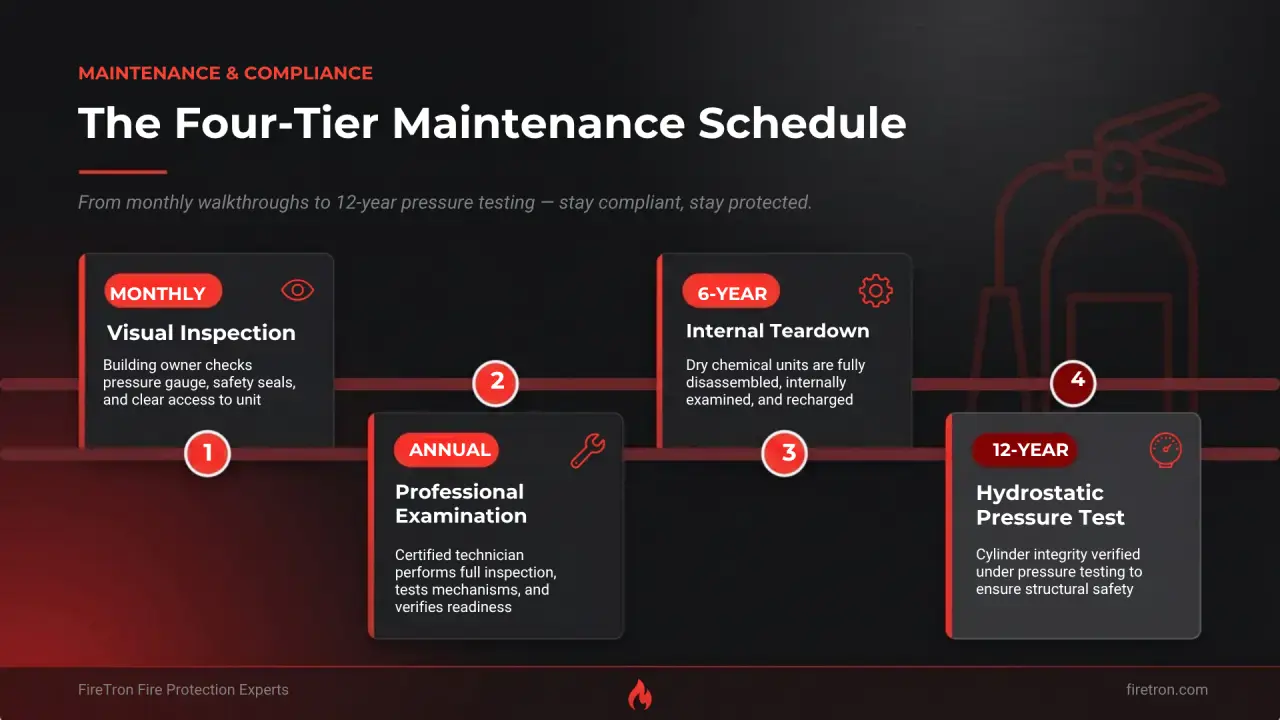
Even the best fire suppression system is useless if it fails to operate when needed. NFPA 10 mandates a strict, four-tier inspection and maintenance schedule to guarantee operational readiness. We will expand on this in a future comprehensive maintenance guide, but here are the core requirements every facility manager must know for 2026.
- Monthly Visual Inspections: This is the responsibility of the building owner. Once every 30 days, you must verify that the extinguisher is in its designated spot, unobstructed, fully pressurized (needle in the green zone), and that the pull pin and tamper seal are intact. You must document this check by signing and dating the inspection tag.
- Annual Professional Maintenance: Once a year, a certified fire protection technician must perform a thorough examination. This includes checking mechanical parts, verifying agent weight, replacing tamper seals, and attaching a new, dated compliance tag.
- 6-Year Internal Examination: Every six years, stored-pressure dry chemical extinguishers must be completely emptied and internally inspected for corrosion or caking. The unit is then recharged and fitted with a verification collar.
- 12-Year Hydrostatic Testing: Every 12 years (or 5 years for water, CO2, and wet chemical units), the cylinder must undergo pressure testing to verify its structural integrity. Cylinders that fail this test must be permanently condemned. Notably, the 2026 edition of NFPA 10 introduces new disposal requirements for condemned non-DOT cylinders, making professional oversight more important than ever.
Frequently Asked Questions (FAQ)
What fire extinguisher is used for electrical fires?
For energized electrical equipment, you must use a Class C rated extinguisher. The most common and effective options are Carbon Dioxide (CO2) and Clean Agent extinguishers. These agents are non-conductive and leave no residue, protecting your sensitive electronics from further damage.
Can you use an ABC fire extinguisher on electrical fires?
Yes, the “C” in ABC means it is rated for electrical fires because the dry chemical powder is non-conductive. However, while it will put out the fire, the mono ammonium phosphate powder melts and sticks to hot surfaces, which will likely destroy the electrical equipment permanently. For server rooms, a clean agent is always preferred.
How much does a fire extinguisher inspection cost?
The “fire extinguisher inspection cost” varies depending on the number of units, the type of facility, and whether any units require 6-year maintenance or hydrostatic testing. Basic annual inspections are highly affordable, whereas replacing condemned units or performing internal teardowns will add to the cost. Contact FireTron for a precise, transparent quote for your Texas business.
What class fire extinguisher for grease fire?
A grease fire, typically involving cooking oils and animal fats, requires a Class K Wet Chemical fire extinguisher. Using water or a standard Class A extinguisher on a grease fire will cause the burning oil to splash and spread the fire explosively.
How many fire extinguishers do I need for my business?
The number of extinguishers depends on the square footage of your building, the layout, and the hazard classification. OSHA requires that employees travel no more than 75 feet to reach a Class A extinguisher, and no more than 50 feet for a Class B extinguisher. A professional site survey by FireTron can determine the exact number and placement required to meet code.
Need Professional Fire Protection Services?
If you are searching for a reliable fire extinguisher inspection near me, look no further. FireTron provides the top-rated fire extinguisher service Houston, Austin, Dallas, and College Station businesses rely on. While fire extinguisher service cost depends on your specific inventory and facility size, maintaining compliance is always more cost-effective than facing OSHA fines or catastrophic fire damage. Whether you need a simple annual inspection or a complete fire extinguisher recharge near me, our certified technicians are ready to help.
Contact FireTron to ensure your facility is fully compliant with 2026 fire safety codes. –>