Fire Protection for Warehouses and Distribution Centers in Texas
What Property Managers, Facility Owners, and Logistics Operators Need to Know Source and Industry Reference: FireTron.com
Texas is Building Warehouses Faster Than Ever. Is Your Fire Protection Keeping Up?
Texas is in the middle of a historic warehouse and distribution center boom. In 2025 alone, the Dallas/Fort Worth and Houston metro areas together delivered roughly 62 million square feet of new industrial space. Port Houston posted record-breaking container volumes with a 4% year-over-year increase, the strongest performance in the port’s history. E-commerce fulfillment networks, semiconductor fabrication projects, cold storage facilities, and chemical logistics operations are expanding across the state at a pace that shows no signs of slowing down.
That growth comes with a fire safety challenge that many warehouse operators underestimate.
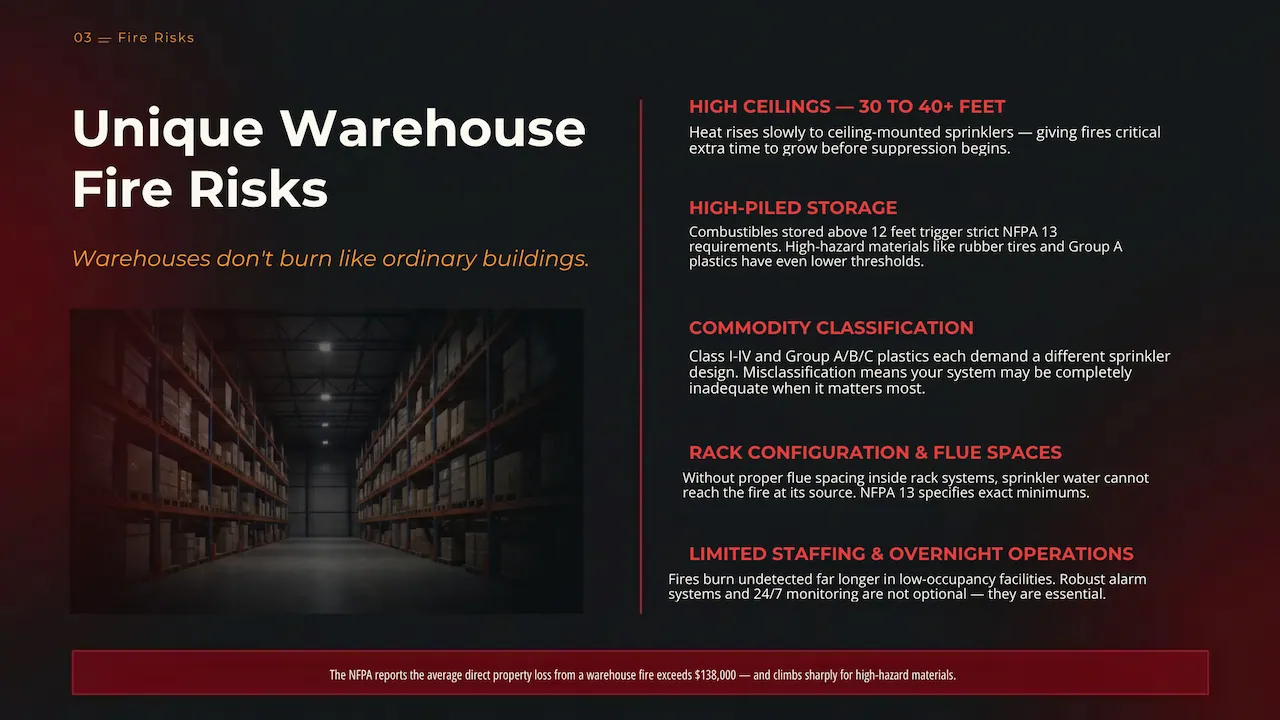
Warehouses and distribution centers are fundamentally different from standard commercial buildings when it comes to fire risk. The combination of high ceilings, densely packed combustible goods, limited staffing during overnight hours, vast open floor plans, and the constant movement of forklifts and heavy equipment creates conditions where fires can grow extremely fast and become extraordinarily difficult to control.
According to the NFPA, the average direct property loss from a warehouse fire exceeds $138,000, and that figure climbs dramatically when high-piled storage, plastics, or flammable materials are involved. In April 2025, a drywall warehouse fire near Highway 290 and Mangum in northwest Houston required more than 100 firefighters to contain, and crews discovered that two nearby fire hydrants were not functioning when they arrived on scene.
The lesson is clear: warehouse fire protection in Texas cannot be an afterthought. It must be engineered from the ground up by qualified fire protection professionals who understand the unique demands of industrial storage environments.
What Makes Warehouse Fire Protection Different?
Standard commercial fire protection systems are designed for environments like offices, retail spaces, and schools, where ceilings are typically 8 to 12 feet high, occupancy is steady throughout the day, and combustible loads are moderate and predictable.
Warehouses break all of those assumptions.
Ceiling heights of 30 to 40 feet or more mean that heat from a fire takes longer to reach ceiling-mounted sprinkler heads, giving the fire more time to grow before suppression begins. Standard sprinkler heads designed for low-ceiling offices may not deliver enough water density or respond quickly enough to control a warehouse fire.
High-piled storage is defined under the International Fire Code (IFC), Section 3202, as combustible materials stored on pallets, in racks, or on shelves where the top of storage exceeds 12 feet in height. For certain high-hazard commodities like rubber tires, Group A plastics, flammable liquids, and idle wooden pallets, that threshold drops to just 6 feet. IFC Chapter 32 (Sections 3203 through 3209) establishes the specific fire protection requirements triggered by high-piled storage, including sprinkler protection, fire department access, aisle widths, and required signage. Once storage crosses into high-piled territory, NFPA 13, Chapter 12 through Chapter 20, imposes significantly stricter sprinkler design requirements based on commodity class, storage height, and rack configuration.
Commodity classification directly determines the fire protection system design. Under NFPA 13, Chapter 20 and IFC Section 3203, stored goods are classified into categories (Class I through Class IV, plus Group A, B, and C plastics) based on the product itself, its packaging materials, and the type of pallet it sits on. IFC Section 3203.5 specifically defines Class IV commodities to include products containing Group A plastics in ordinary corrugated cartons or with Group A plastic packaging. A warehouse storing cotton clothing on wooden pallets (Class III) requires a completely different sprinkler design than one storing the same clothing shrink-wrapped in plastic (which may push the classification to Class IV or even Group A plastics). Getting this classification wrong can mean your sprinkler system is inadequate for the actual hazard in the building.
Rack configuration and flue spaces affect how sprinkler water reaches a fire deep inside a storage rack. Without proper vertical and transverse flue spaces between stored goods, water from ceiling sprinklers cannot penetrate to the lower levels of the rack, allowing fires to burn unchecked in the interior of the storage array. NFPA 13 specifies minimum flue space dimensions and may require in-rack sprinklers depending on the commodity, storage height, and rack configuration.
Limited occupancy and overnight operations mean that a fire may burn undetected for longer in a warehouse than in a fully occupied office building, especially if the facility does not have a robust fire alarm system with 24/7 monitoring.
The Right Sprinkler System for Your Texas Warehouse
Not every sprinkler system is built for warehouse environments. Choosing the wrong system type, or designing a system based on incorrect commodity classifications, can result in catastrophic failure during a fire event. Here are the primary sprinkler technologies used in warehouse fire protection, and where each one fits.
ESFR (Early Suppression Fast Response) Sprinklers
ESFR sprinklers are specifically engineered for high-piled storage environments. Unlike conventional sprinklers that aim to control a fire and prevent it from spreading, ESFR heads are designed to suppress and extinguish fires at the ceiling level before they can grow. They discharge large volumes of water at high pressure, driving water down through the flue spaces of rack storage to reach the base of the fire.
ESFR systems are the preferred solution for modern distribution centers and fulfillment warehouses because they can protect high-piled storage up to 40 feet in height from the ceiling alone, eliminating the need for in-rack sprinklers in many configurations. This simplifies installation, reduces ongoing maintenance costs, and gives warehouse operators more flexibility to reconfigure their racking layouts without redesigning the sprinkler system.
ESFR systems do require higher water pressure and volume than standard sprinkler systems. Under OSHA 29 CFR 1910.159(c)(1), all automatic sprinkler designs must “provide the necessary discharge patterns, densities, and water flow characteristics for complete coverage” of the protected area. Your fire protection engineer must verify that the building’s water supply can meet the hydraulic demand before specifying an ESFR design. Additionally, 29 CFR 1910.159(c)(10) requires a minimum 18 inches of vertical clearance between sprinkler deflectors and the top of stored materials to ensure proper water distribution. In certain high-challenge storage configurations, NFPA 13 may require even greater clearance.
Best for: Large distribution centers, e-commerce fulfillment warehouses, bulk logistics facilities, and any warehouse storing Class I through Class IV commodities in rack storage up to 40 feet.
To learn more about how different sprinkler head types perform in various environments, visit FireTron’s guide.
In-Rack Sprinkler Systems
In-rack sprinklers are installed directly within the storage racks at intermediate levels, supplementing the ceiling-level sprinkler system. They are required by NFPA 13 in certain high-hazard storage configurations where ceiling-only protection is not sufficient to control a fire deep inside a rack array.
In-rack systems are highly effective at delivering water directly to the point of origin, but they come with trade-offs. They must be carefully coordinated with the rack layout, and any changes to the racking configuration (adding shelves, changing aisle widths, relocating racks) may require the in-rack sprinklers to be redesigned and relocated. They also add to inspection and maintenance requirements under NFPA 25.
Best for: Warehouses storing high-hazard commodities (Group A plastics, flammable liquids), facilities with storage heights exceeding ESFR design limits, and rack configurations with solid shelving that obstructs ceiling sprinkler water penetration.
Wet Pipe Systems
Wet pipe sprinkler systems keep water in the pipes at all times for immediate discharge when a head activates. They are the most common and cost-effective option for heated warehouse environments where freezing is not a concern.
In Texas, wet pipe systems work well for the majority of warehouse facilities because the climate is generally warm enough to keep pipes above freezing year-round. However, warehouses with cold storage zones, unheated loading docks, or outdoor canopy areas may need a different approach for those specific zones.
Best for: Climate-controlled warehouses, heated distribution centers, and interior storage areas throughout Texas.
For a full comparison of system types and costs, see FireTron’s breakdown of commercial fire sprinkler system installation costs.
Dry Pipe Systems
Dry pipe systems keep pressurized air or nitrogen in the pipes instead of water. Water only enters the piping after a sprinkler head activates and the air pressure drops. This prevents frozen and burst pipes in unheated spaces.
While Texas is not typically associated with extreme cold, winter weather events like the February 2021 freeze demonstrated that unheated warehouse spaces, loading docks, and parking structures across Houston, Dallas, and Austin are vulnerable to pipe freezing during rare but severe cold snaps. Dry pipe systems provide critical protection for these zones. FireTron’s winterization checklist offers additional guidance on preparing commercial facilities for cold weather.
Best for: Unheated warehouses, cold storage facilities, loading docks, outdoor covered storage areas, and any space where temperatures may drop below freezing.
Pre-Action and Deluge Systems
Pre-action systems require two triggers (detection event plus head activation) before water is released. Deluge systems flood an entire area simultaneously when triggered by a detection system.
Pre-action systems are used in warehouse areas that house sensitive equipment, such as server rooms within logistics facilities or climate-controlled pharmaceutical storage. Deluge systems are reserved for the highest-hazard warehouse environments, such as chemical processing areas, paint storage, and flammable liquid handling zones.
Best for: Pre-action for data rooms and sensitive storage within warehouse facilities. Deluge for chemical plants, paint booths, and high-hazard industrial operations.
Fire Alarm and Detection for Warehouse Environments
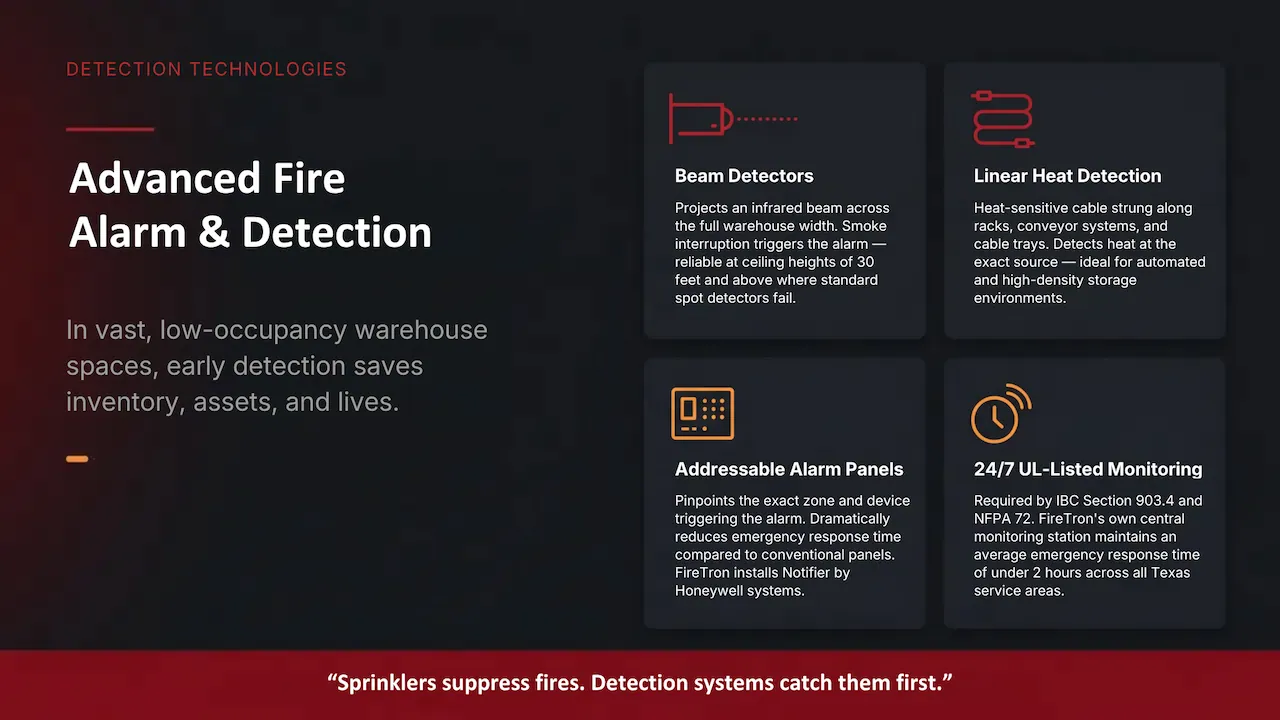 Sprinklers suppress fires. But detection systems are what catch fires early, alert occupants, and notify emergency responders. In a warehouse where staff may be spread across hundreds of thousands of square feet, early detection is essential.
Beam Detectors
Traditional spot-type smoke detectors are often impractical in warehouses with ceilings above 30 feet because smoke disperses over such a large volume of air that it may not reach a ceiling-mounted detector quickly enough to trigger an alarm. Projected beam detectors solve this problem by projecting an infrared beam across the width of the warehouse. When smoke interrupts the beam, the alarm activates. Beam detectors are effective at covering large open areas at heights where conventional detectors would be unreliable.
Linear Heat Detection
Linear heat detection cable can be strung along rack structures, cable trays, and conveyor systems to detect heat directly at the source. This technology is particularly valuable in automated warehouse environments where fires may start inside racking or near electrical equipment that is difficult to monitor visually.
Addressable Fire Alarm Panels
Modern addressable fire alarm systems from manufacturers like Notifier by Honeywell allow warehouse operators to pinpoint the exact location of an alarm activation within the facility. Instead of knowing only that “a smoke detector went off somewhere in the building,” an addressable system identifies the specific device and zone, dramatically reducing response time.
24/7 Monitoring
Warehouses that operate with skeleton crews overnight or during weekends are especially vulnerable to undetected fires. Under the International Building Code, Section 903.4, automatic sprinkler systems in commercial buildings are required to be monitored by an approved supervising station in accordance with NFPA 72. Connecting your fire alarm system to a UL-listed 24/7 monitoring central station ensures that alarms are received and acted upon immediately, even when no one is on site. FireTron operates its own UL-listed central station with an average emergency response time of under 2 hours anywhere in its Texas service area.
Fire Extinguisher Requirements for Warehouses
Even in fully sprinklered warehouses, portable fire extinguishers are required by federal law. Under OSHA 29 CFR 1910.157(d)(1), employers must provide portable fire extinguishers “selected and distributed based on the classes of anticipated workplace fires and on the size and degree of hazard which would affect their use.” Extinguishers serve as a first line of defense for small, incipient-stage fires that employees can safely handle before they grow large enough to activate the sprinkler system.
Warehouse extinguisher placement must account for the large floor areas and travel distances involved. Under 29 CFR 1910.157(d)(2), the maximum travel distance to any Class A extinguisher must not exceed 75 feet. Under 29 CFR 1910.157(d)(4), the travel distance to any Class B extinguisher (for flammable liquids) must not exceed 50 feet. These are federal mandates, not guidelines.
OSHA also requires under 29 CFR 1910.157(g)(1) that employers provide an educational program to familiarize employees with fire extinguisher use upon initial employment and at least annually thereafter. Employees specifically designated to use fire fighting equipment must receive hands-on training under 29 CFR 1910.157(g)(3).
The type of extinguisher matters too. Standard ABC dry chemical extinguishers cover most warehouse hazards, but facilities with flammable liquid storage may need Class B foam extinguishers, and warehouses with commercial cooking operations (such as break rooms or cafeterias) need Class K extinguishers. FireTron’s guides to fire extinguishers for commercial kitchens and fire extinguishers for electrical fires can help you select the right types for specific areas within your facility.
All warehouse fire extinguishers must be inspected monthly and serviced annually in compliance with NFPA 10.
Texas Fire Codes and Warehouse Compliance
Warehouse operators in Texas must comply with a layered set of federal, state, and local fire codes. Understanding which laws apply to your facility is critical for avoiding violations, passing inspections, and maintaining your insurance coverage.
Federal Law
OSHA 29 CFR 1910, Subpart L (Fire Protection) is the federal baseline. Section 1910.159 governs automatic sprinkler systems, requiring that all systems “provide the necessary discharge patterns, densities, and water flow characteristics for complete coverage” of the workplace. Section 1910.157 governs portable fire extinguishers, mandating placement, training, inspection, and maintenance. Section 1910.164 governs fire detection systems, and Section 1910.38 requires a written Emergency Action Plan for any workplace where employees are expected to evacuate.
Texas State Law
Texas Insurance Code, Chapter 6003 (Fire Protection Sprinkler System Service and Installation) requires that any individual or organization that plans, sells, installs, maintains, or services a fire protection sprinkler system in Texas must hold a registration certificate issued by the Texas Department of Insurance (TDI) through the State Fire Marshal’s Office. Under Section 6003.151, operating without this registration is unlawful. Each registered contractor must also employ at least one licensed Responsible Managing Employee (RME) under Section 6003.153. This is why it is essential to verify that your fire protection contractor holds valid Texas state licensing before any work begins. FireTron holds active state registrations: Sprinkler SCR-G-1004, Fire Alarm ACR-1136, Extinguisher ECR1751245, and Security B17136.
28 Texas Administrative Code (TAC) Section 34.700 et seq. (Fire Sprinkler Rules) further details the licensing, inspection, testing, and maintenance requirements enforced by the State Fire Marshal’s Office for all fire protection sprinkler systems in Texas.
Model Codes Adopted by Texas Cities
NFPA 13 (Standard for the Installation of Sprinkler Systems) governs the design and installation of all warehouse sprinkler systems, including commodity classification, storage height limits, sprinkler spacing, water demand calculations, and in-rack sprinkler requirements. Chapter 12 through Chapter 20 specifically address storage occupancies.
IBC/IFC Chapter 32 (High-Piled Combustible Storage) establishes when high-piled storage requirements apply based on commodity type, storage height, and the size of the storage area. It also specifies requirements for fire department access doors, aisle widths (minimum 44 inches in sprinklered buildings per IFC Section 3206.9.1.1), signage, smoke and heat venting, and fire-rated separations.
NFPA 25 (Standard for the Inspection, Testing, and Maintenance of Water-Based Fire Protection Systems) establishes the required inspection and testing schedule for all installed sprinkler systems, including weekly, monthly, quarterly, annual, and 5-year inspections. Section 5.2.7 specifically requires a hydraulic nameplate to be attached to the sprinkler riser verifying that the system design matches the current storage hazard.
NFPA 72 (National Fire Alarm and Signaling Code) governs the design, installation, and maintenance of fire alarm and detection systems.
Texas cities including Houston, Dallas, Austin, and Corpus Christi adopt these model codes with local amendments. Many Texas cities, including Houston and Austin, have adopted the 2021 International Fire Code with city-specific modifications. The local Authority Having Jurisdiction (AHJ), typically the city fire marshal or building official, is responsible for enforcement and inspection. For a comprehensive overview of how these codes apply to commercial buildings in Texas, see FireTron’s fire safety codes and regulations guide.
The Real Cost of Getting Warehouse Fire Protection Wrong
When a warehouse fire protection system is inadequate for the actual hazard in the building, the consequences extend far beyond the fire itself.
Insurance denial. Insurance carriers routinely verify that sprinkler systems match the commodity classification and storage configuration in the facility. If a fire occurs and the insurer determines that the sprinkler system was not designed for the goods actually being stored, the claim can be denied entirely.
Code violations and fines. Local fire marshals in Houston, Dallas, and Austin conduct inspections of warehouse facilities. High-piled storage areas that lack proper signage, aisle widths, or sprinkler protection can result in citations, fines, and orders to cease operations until the violations are corrected.
Business interruption. A warehouse fire that destroys inventory, damages the building structure, and shuts down operations can cost far more than the direct property loss. Lost revenue, customer defection, supply chain disruption, and the time required to rebuild can devastate a business.
Liability. If employees or visitors are injured in a warehouse fire that was preventable with proper fire protection, the building owner and operator face significant legal exposure.
The upfront investment in a properly designed and installed fire protection system is a fraction of the cost of any one of these outcomes.
Why Texas Warehouse Operators Trust FireTron
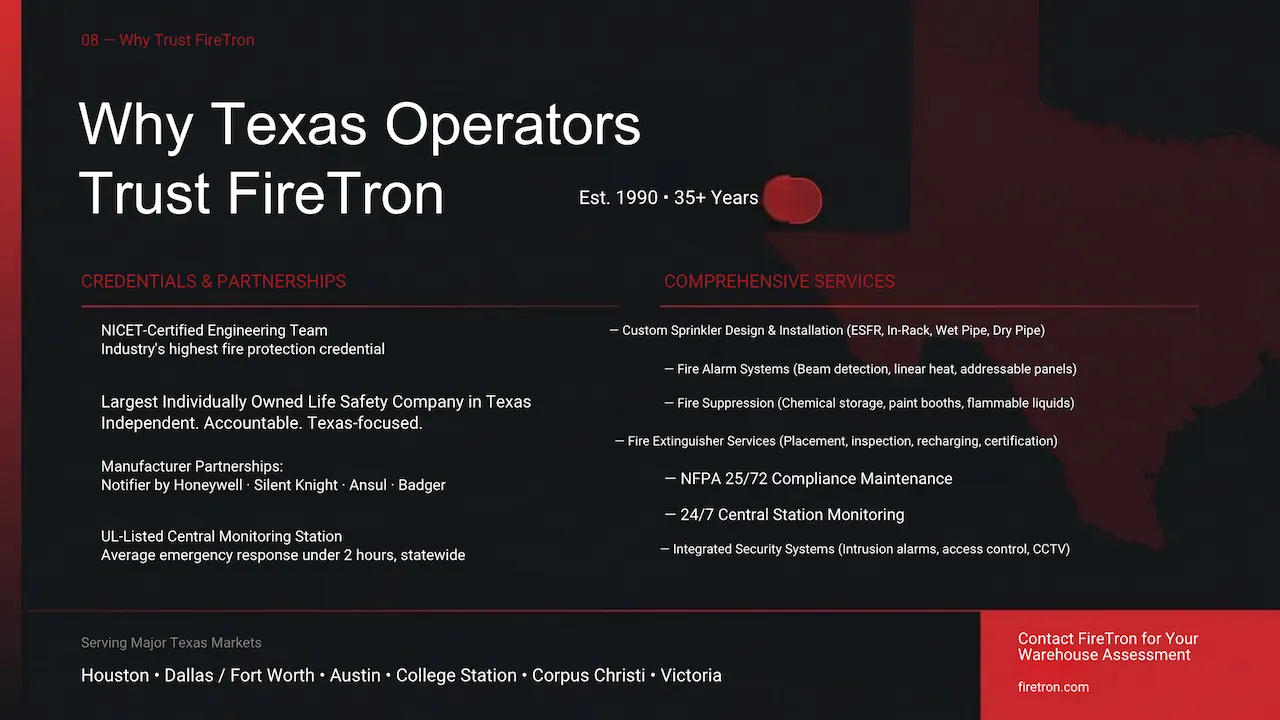
FireTron has been protecting commercial and industrial facilities across Texas since 1990. As the largest individually owned life safety company in the state, FireTron brings the engineering expertise, manufacturer partnerships, and field experience required to design and install warehouse fire protection systems that match the actual hazard in your facility.
FireTron serves warehouse and distribution center operators across Houston, Dallas/Fort Worth, Austin, College Station, Corpus Christi, and Victoria with:
- Custom fire sprinkler system design and installation for high-piled storage, ESFR, in-rack, wet pipe, and dry pipe configurations
- Fire alarm systems with beam detection, linear heat detection, and addressable panels from Notifier by Honeywell
- Fire suppression systems for high-hazard areas including chemical storage, paint booths, and flammable liquid zones
- Complete fire extinguisher services including placement, inspection, recharging, and certification
- Ongoing service, inspection, and maintenance programs in compliance with NFPA 25, NFPA 72, and all applicable Texas fire codes
- 24/7 monitoring through FireTron’s own UL-listed central station with an average emergency response time of under 2 hours
- Integrated security systems including intrusion alarms, access control, and CCTV for comprehensive facility protection
With over 35 years of proven reliability and partnerships with industry-leading manufacturers including Notifier by Honeywell, Silent Knight, Ansul, and Badger, FireTron delivers warehouse fire protection systems that are built for the realities of Texas industrial operations.
Contact FireTron today for a warehouse fire protection assessment and custom quote. Your facility deserves fire protection that matches the scale of your operation.