Fire Extinguisher Service Requirements for Commercial Facilities in Texas
Ensuring compliance with fire safety regulations is a primary responsibility for commercial facility managers and property owners across Texas. Maintaining fully functional fire extinguishers is not just a regulatory obligation; it is an essential life safety measure that protects your workforce, visitors, and physical assets from unexpected workplace fires. A dependable fire extinguisher service guarantees that your safety devices will operate correctly when an emergency occurs.
Understanding the local, state, and national mandates surrounding fire safety equipment can be complex. From routine visual checks to annual professional certifications and multi-year maintenance, commercial buildings must adhere to strict guidelines enforced by local Fire Marshals and state authorities. Partnering with a professional fire extinguisher company helps property owners maintain continuous compliance and operational readiness.
Understanding Texas Commercial Fire Extinguisher Compliance Standard
Commercial fire protection standards in Texas are primarily governed by the Texas State Fire Marshal’s Office (SFMO) alongside standards set by the National Fire Protection Association (NFPA). Specifically, NFPA 10 outlines the standard for portable fire extinguishers, detailing strict rules for selection, placement, inspection, testing, and overall maintenance.
Texas law requires that any commercial property, whether an office building in Dallas, an industrial facility in Houston, a healthcare site in Austin, or a retail hub in San Antonio, maintains accessible and operational fire extinguishers. Local jurisdictions may enforce additional municipal fire codes, making regular maintenance and professional oversight vital to avoid severe fines, operational shutdowns, or insurance claim denials following an incident.
Key Components of a Complete Commercial Fire Extinguisher Inspection
A compliant commercial fire extinguisher program requires three distinct levels of review: monthly visual checks, annual professional service, and periodic internal maintenance.
1. Monthly Visual Inspections
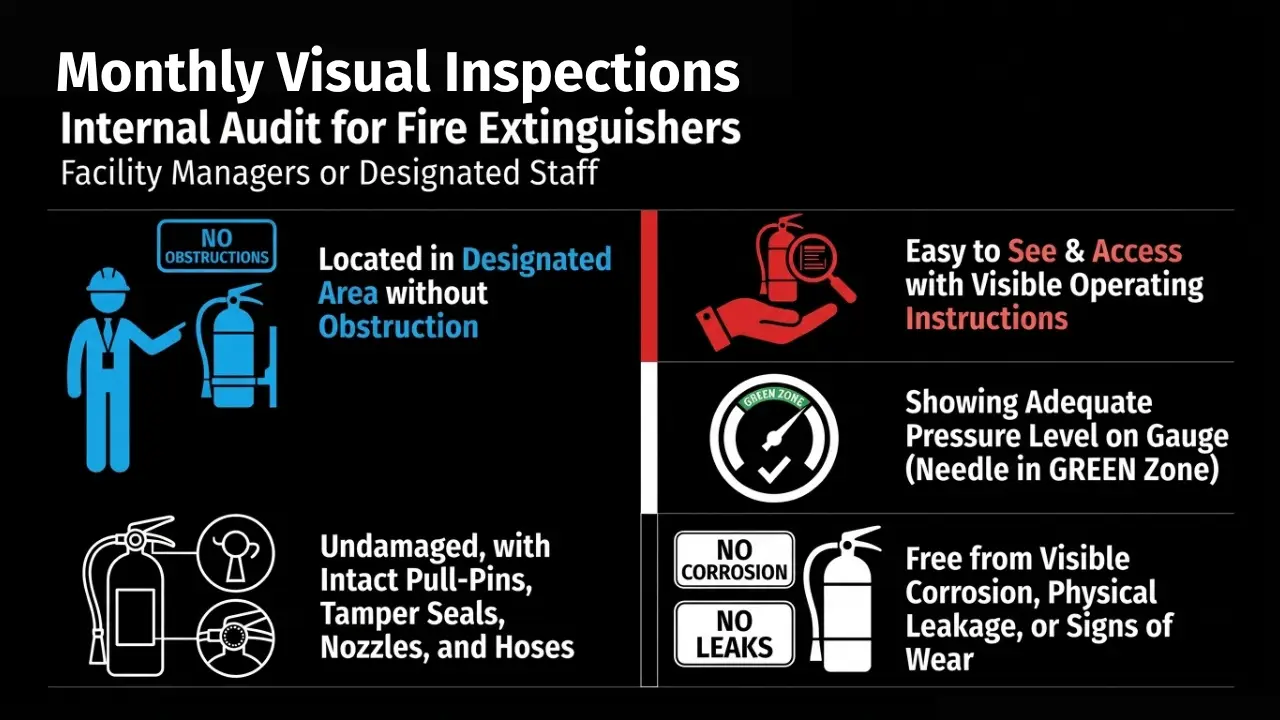
Facility managers or designated staff members must perform simple monthly visual checks. These internal audits ensure that each unit is:
- Located in its designated area without obstruction.
- Easy to see and access with visible operating instructions facing outward.
- Showing adequate pressure level on the gauge (the needle must remain in the green zone).
- Undamaged, with intact pull-pins, tamper seals, nozzles, and hoses.
- Free from visible corrosion, physical leakage, or signs of wear.
2. Annual Professional Fire Extinguisher Inspection
At least once every 12 months, Texas regulations mandate an in-depth professional inspection by a licensed technician. During an annual service visit, a technician will:
- Examine the mechanical parts, discharge hose, and locking pin.
- Verify that the extinguisher weight and pressure match manufacturer specifications.
- Check the unit against location-specific hazard requirements.
- Attach a new, state-approved inspection tag indicating the date of service and technician licensing details.
3. Periodic Maintenance: 6-Year Internal Maintenance and 12-Year Hydrostatic Testing
Over time, stored-pressure fire extinguishers require internal maintenance to ensure structural integrity and proper chemical performance:
- 6-Year Maintenance: Stored-pressure dry chemical extinguishers must be emptied, inspected internally for corrosion, and recharged every six years.
- 12-Year Hydrostatic Testing: Every 12 years (or 5 years for certain CO₂ and water-based units), extinguishers must undergo hydrostatic pressure testing to verify that the cylinder can safely contain its operating pressure.
Expert Perspective on Fire Extinguisher Readiness
Regular maintenance of life safety systems significantly reduces property loss and personal injury during emergency situations.
“Portable fire extinguishers can save lives and property by putting out a small fire or containing it until the fire department arrives, but they must be properly selected, placed, and maintained to function effectively.”
Fire Extinguisher Placement and Hazard Classification
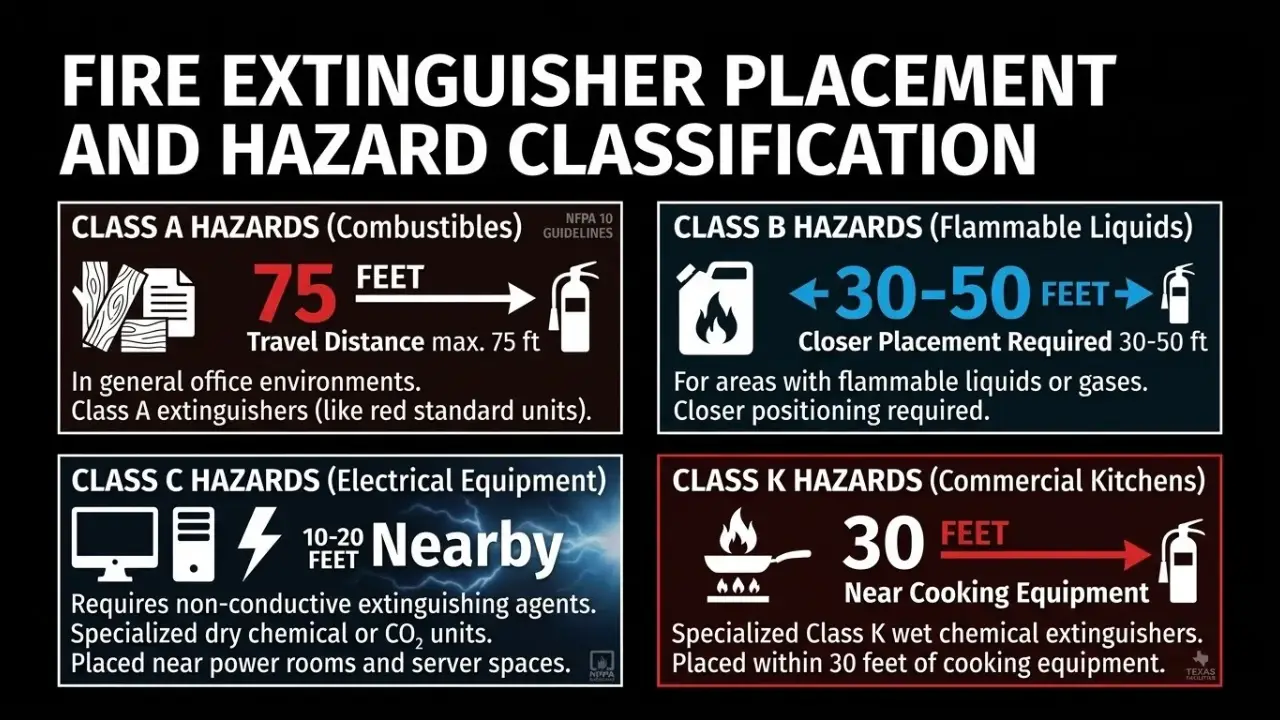
To ensure adequate coverage, Texas facilities must select and position fire extinguishers based on specific building layouts and risk factors. According to NFPA 10 guidelines:
- Class A Hazards (Combustibles): In general office environments, travel distance to a Class A fire extinguisher should not exceed 75 feet.
- Class B Hazards (Flammable Liquids): Areas housing flammable liquids or gases require closer extinguisher placement, typically within 30 to 50 feet depending on the hazard severity.
- Class C Hazards (Electrical Equipment): Electrical risks require non-conductive extinguishing agents, such as specialized dry chemical or CO₂ units placed near power rooms and server spaces.
- Class K Hazards (Commercial Kitchens): Restaurants and commercial kitchens require specialized Class K wet chemical fire extinguishers within 30 feet of cooking equipment.
Working with an experienced provider ensures proper placement and adherence to local fire codes across all facility zones.
Choosing the Right Fire Protection Partner in Texas
Maintaining full compliance across multiple commercial properties requires a dedicated partner who understands the complexities of state and local regulations. Comprehensive commercial fire extinguisher service includes full-lifecycle support, from initial hazard assessment and installation to routine inspection, testing, and emergency recharge.
Selecting a certified partner eliminates compliance guesswork, keeping your building code-compliant and prepared for unexpected emergencies. Comprehensive fire safety strategies often incorporate integrated protection systems, combining portable units with fire extinguisher maintenance and centralized life safety infrastructure.
Commercial Fire Safety Compliance FAQ
How often do commercial fire extinguishers need to be inspected in Texas?
Texas requires monthly visual checks by facility personnel and a comprehensive annual inspection performed by a state-licensed technician.
What happens if a commercial building fails a fire inspection?
Failing a fire inspection can result in formal citations, municipal fines, conditional occupancy permits, or potential operational delays until all safety deficiencies are corrected.
Can facility staff perform annual fire extinguisher inspections?
No. While trained staff can perform informal monthly visual checks, annual inspections and official tag certifications must be completed by a licensed fire protection professional licensed through the Texas State Fire Marshal’s Office.
Industry Impact Fact: According to data analyzed by the National Fire Protection Association (NFPA), portable fire extinguishers successfully extinguish or control approximately 84% of fires in commercial and industrial settings when operated by trained personnel.
Ensuring your property meets all regulatory requirements keeps your business operational, protected, and fully safe. To discuss your commercial facility needs or schedule a complete safety audit, contact FireTron today.