Where Should Businesses Place FCL-X Fire Extinguishers for Lithium Battery Risk?
The rapid integration of lithium-ion batteries into commercial workflows has created a unique set of safety challenges for facility managers, property owners, and industrial operations. From warehouse logistics utilizing electric forklifts to dedicated corporate charging bays, these high-energy-density power sources present severe thermal runaway hazards that traditional fire suppression equipment cannot safely manage. Effectively mitigating this danger requires specialized equipment and strategic positioning.
Implementing specialized solutions, such as FCL-X portable units, is becoming standard protocol for high-risk zones. However, simply acquiring the right equipment is only half the battle. To ensure continuous operational safety and full regulatory compliance, understanding the exact parameters of lithium-ion battery fire extinguisher placement is critical to protecting personnel, inventory, and infrastructure.
Understanding the Specific Risks of Commercial Lithium Battery Storage Safety
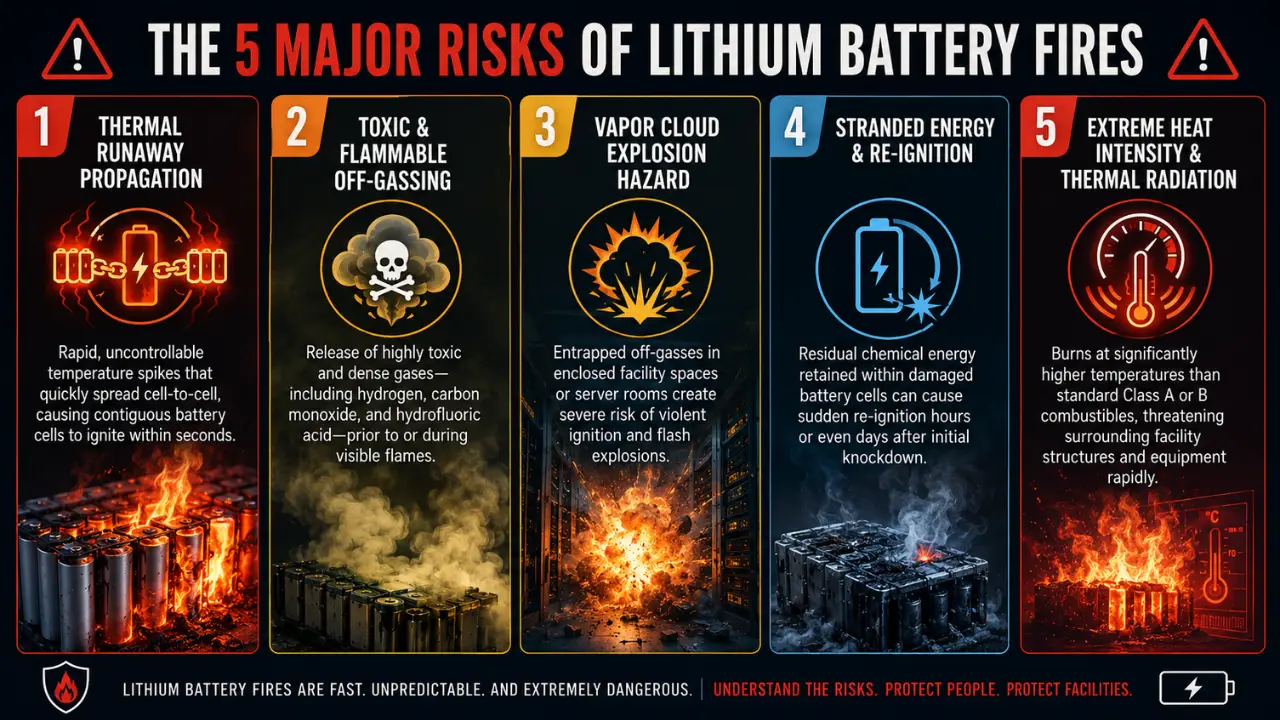
Standard fires involving wood, paper, or even traditional electrical components behave predictably. Lithium-ion battery fires do not. When a cell shorts, overcharges, or suffers mechanical damage, it enters a state known as thermal runaway. This is an accelerating internal chemical reaction that generates intense heat, throws off toxic gases, and creates self-sustaining fires that resist standard extinguishing agents.
Because these incidents cascade rapidly from a single cell to an entire localized array, basic fire safety planning must evolve. Standard dry chemical or CO₂ units are often insufficient because they do not cool the internal battery chemistry, allowing the fire to reignite minutes or hours later. Specialized FCL-X units utilize advanced agents designed to specifically smother and cool lithium-ion cells simultaneously. Ensuring these tools are positioned correctly across your facility directly determines how effectively an emerging hazard can be contained before it triggers a catastrophic building-wide incident.
Strategic Extinguisher Locations for Lithium Battery Charging Area Fire Safety
Dedicated charging zones represent one of the highest-frequency risk areas in any industrial or corporate facility. The continuous transfer of electrical energy creates thermal stress, making precise placement within these spaces non-negotiable for lithium battery charging area fire safety.
The Safe Distance Rule
A common mistake is placing safety equipment directly next to or above the charging racks. If a thermal runaway event occurs, the immediate vicinity will quickly become engulfed in thick, toxic smoke and intense radiant heat, rendering the extinguisher entirely inaccessible. Instead, mount units along the designated escape path, at least 15 to 30 feet away from the actual charging stalls. This ensures that an employee can safely access the equipment without walking directly into the hazard zone.
Signage and Height Parameters
Every FCL-X extinguisher must be highly visible and completely unobstructed. In busy commercial spaces, stackers, pallets, or structural columns can easily block lines of sight.
- Mount units so that the operating instructions face outward toward the main aisle.
- Install high-visibility, photoluminescent directional signs above each station so they can be located even during a sudden power failure or heavy smoke accumulation.
- Adhere strictly to standard accessibility heights: units weighing under 40 pounds should have their tops mounted no higher than 5 feet above the floor, with a minimum 4-inch clearance from the bottom to prevent moisture damage.
Optimizing Warehouse Lithium Battery Fire Protection and Storage Arrays
Bulk storage environments require an entirely different tactical approach compared to localized charging stations. Large-scale distribution centers and logistics hubs often stack lithium-ion inventories or battery-powered equipment deep within high-pile racking systems, necessitating advanced infrastructure planning for warehouse lithium battery fire protection.
“The main challenge with lithium-ion battery fires is that they involve a combination of chemical, electrical, and Class A fire hazards, creating a self-sustaining loop that requires specialized mitigation strategies beyond typical commercial fire hazards.”
— National Fire Protection Association (NFPA)
In massive industrial spaces, relying on a single centralized safety hub is a major compliance risk. Travel distance matters. Personnel should never have to travel more than 50 to 75 feet to reach a specialized extinguisher when navigating a high-risk sector. For facilities with extensive storage footprints, FCL-X units should be distributed systematically at the ends of storage aisles, near main intersecting walkways, and adjacent to shipping and receiving staging docks where mechanical impacts from forklifts are statistically most likely to occur.
Integrating Portable Units with Commercial Fire Suppression Systems
While portable FCL-X units are invaluable for rapid, manual intervention during the initial stages of an incident, they are designed to complement—not replace—comprehensive building protection systems. True commercial lithium battery storage safety relies on a multi-tiered defense system.
When manual containment is impossible, automated fire suppression systems must take over to protect the broader structural envelope. In environments with dense concentrations of electronics or battery storage, combining strategically placed portable units with specialized clean agent systems or tailored pre-action sprinkler systems provides the ultimate layer of operational security. This integrated methodology ensures that if a fire scales beyond what a hand-held unit can manage, the building’s automated defenses activate immediately to suppress the threat and prevent a total loss of assets.
| Facility Zone | Primary Risk Factor | Optimal FCL-X Placement Parameter |
|---|---|---|
| Charging Bays | Electrical overcharge, localized overheating | 15–30 feet from stalls, along the exit path |
| Bulk Storage Racks | High-pile concentration, cascading failure | Aisle ends, max 75-foot travel distance |
| Staging Docks | Mechanical impact, forklift punctures | Near high-traffic intersections and bay doors |
Maintenance and Compliance for Battery Charging Stations
The reliability of your safety infrastructure depends directly on a proactive upkeep schedule. Installing a high-performance fire extinguisher for battery charging stations is only useful if that unit is fully operational at the exact moment an emergency strikes.
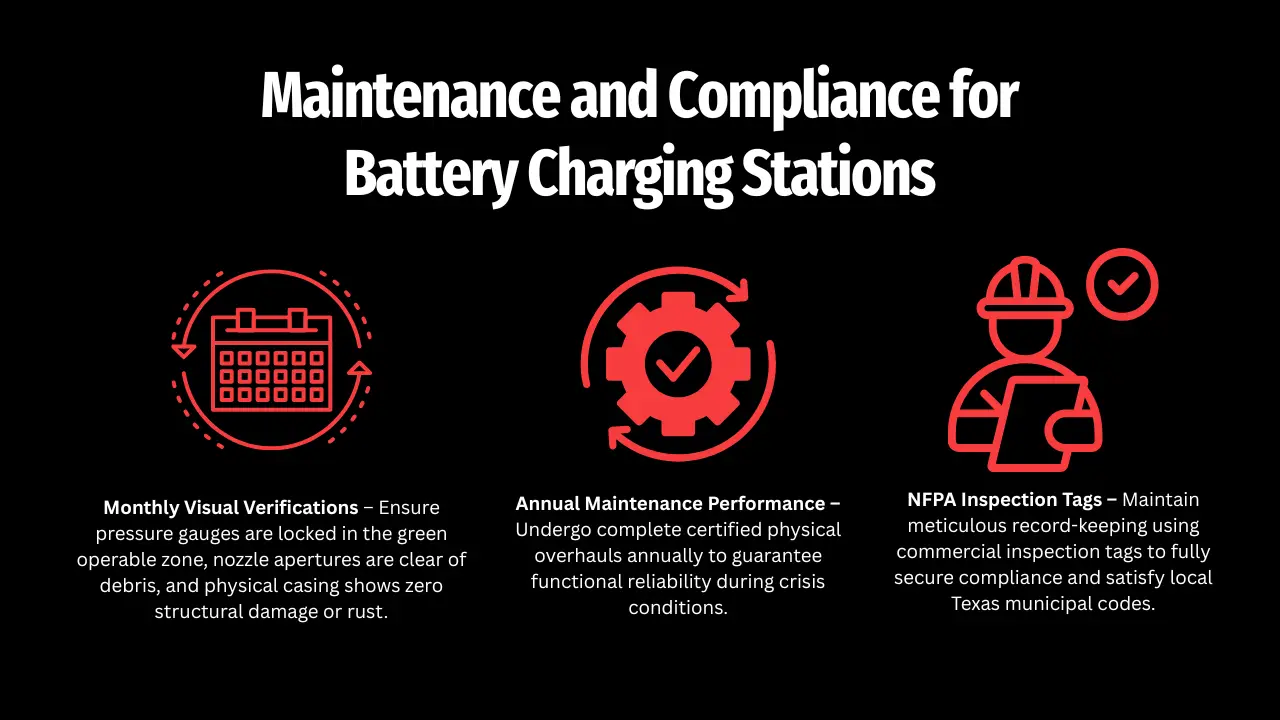
Every specialized unit requires mandatory monthly visual verifications to ensure the pressure gauge remains in the green operable zone, the nozzle is entirely clear of debris, and the physical shell shows no signs of dents or corrosion. Additionally, these units must undergo comprehensive annual physical maintenance performed by certified professionals. Keeping precise records via commercial fire system inspection tags is mandatory under NFPA guidelines and local Texas municipal codes, proving your facility’s ongoing compliance during formal fire marshal walkthroughs.
Partnering with Local Commercial Fire Protection Specialists
Designing an effective safety layout that accounts for modern energy storage risks requires deep, specialized industry expertise. Every commercial facility features unique structural configurations, ventilation patterns, and workflow logistics that dictate customized asset distribution.
Partnering with an experienced provider ensures that your facility’s safety strategy addresses all active liabilities while meeting strict local and national standards. Professional risk assessments take the guesswork out of compliance, creating a secure environment designed to handle evolving industrial hazards safely and effectively.
Partner with Texas’s Trusted Life Safety Specialists. Ensure your Texas commercial facility meets strict local and national safety standards. Contact Firetron today.
Critical Safety Statistic: According to UL Research Institutes. comprehensive fire safety research data, battery-related fires in commercial and industrial settings escalate up to 10 times faster than conventional trash, wood, or paper fires, leaving a minimal window for manual intervention.