What Should Be Used to Extinguish Fires Near Cables and Electrical Equipment
Published by FireTron Experts | Fire Safety & Protection
Electrical failures and malfunctions cause an estimated 24,000 nonresidential building fires in the United States every year [1]. When a fire breaks out near cables, server racks, or energized electrical panels, the situation requires immediate and precise action. Using the wrong fire safety equipment can not only destroy hundreds of thousands of dollars worth of sensitive electronics but also pose a lethal electrocution risk to the person attempting to extinguish the flames.
At FireTron, we have spent over 30 years providing commercial facilities in Texas with top-tier fire protection services. In this comprehensive guide, we will explore exactly what types of fire extinguishers and suppression systems are safe, compliant, and effective for fires involving electrical equipment.
Understanding Class C Electrical Fires
The National Fire Protection Association (NFPA) categorizes fires based on their fuel source. Fires involving energized electrical equipment, such as computers, servers, motors, wiring, and control panels, are classified as Class C fires.
It is important to note that electricity itself does not burn. Instead, an electrical fault acts as the ignition source that sets surrounding materials on fire. These surrounding materials are typically Class A fuels (like paper, rubber cable insulation, or plastics) or Class B fuels (flammable liquids). The primary goal when fighting a Class C fire is to use an extinguishing agent that is electrically non-conductive. If it is safe to do so, the best practice is to de-energize the equipment first, which effectively downgrades the hazard to a Class A or Class B fire.
The Best Fire Extinguishers for Electrical Equipment
When selecting an electrical fire extinguisher, facility managers must prioritize agents that are non-conductive and leave no residue. The following are the most effective and industry-approved options for protecting cables and sensitive electronics.
1. Clean Agent Fire Extinguishers
Clean agents are gaseous fire suppressants that are electrically non-conductive, leave absolutely no residue, and are safe for use in occupied spaces. They are widely considered the superior choice for data centers, telecommunications facilities, and server rooms.
- Halotron I: This is a market-leading clean agent that discharges as a rapidly evaporating liquid. It is an environmentally acceptable replacement for legacy Halon 1211 systems. Halotron extinguishers, such as the Amerex Model 397, offer a superior discharge range of 9 to 15 feet, allowing the operator to maintain a safe distance from the electrical hazard.
- FE-36 and Novec 1230: These modern clean agents have zero ozone depletion potential. Products like the Ansul CLEANGUARD series utilize these agents to provide highly effective suppression without causing thermal shock to delicate circuit boards.
2. Carbon Dioxide (CO2) Fire Extinguishers
A CO2 fire extinguisher for electrical fires is a classic and highly reliable choice. CO2 extinguishers work by discharging a cloud of extremely cold gas that smothers the fire by displacing oxygen.
- Zero Residue: Like clean agents, CO2 dissipates entirely into the atmosphere, eliminating costly cleanup and preventing collateral damage to expensive servers.
- Limitations to Consider: CO2 extinguishers have a shorter effective range of 3 to 8 feet. Furthermore, because they displace oxygen, discharging a CO2 unit in a small, confined server closet can create an asphyxiation hazard for the operator. Proper ventilation and evacuation protocols are mandatory after use.
3. De-ionized Water Mist Extinguishers
While standard water is highly dangerous around electricity, de-ionized water mist extinguishers are a unique exception. Units like the Amerex Model B272 atomize de-ionized water into a fine mist. Because the water lacks conductive ions, the mist is non-conductive and safe for Class C hazards. These are particularly useful in hospital MRI facilities and clean rooms.
FireTron Safety Tip: Always ensure your fire extinguisher has a clear “C” rating on its label before using it near energized cables or electrical panels.
What NOT to Use on Electrical Fires
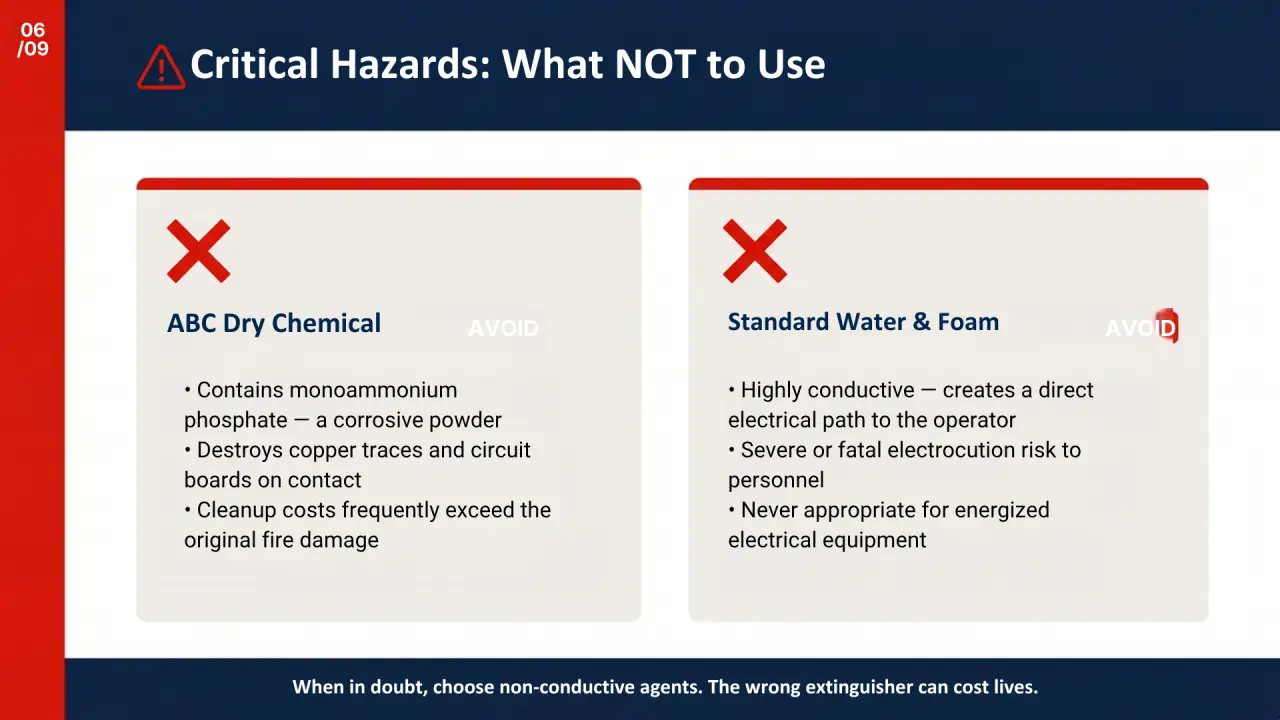
Using the wrong extinguishing agent can worsen the fire, cause severe injuries, or result in catastrophic equipment failure.
ABC Dry Chemical Extinguishers
While ABC dry chemical extinguishers are technically rated for Class C fires, they should never be used in server rooms or near sensitive electronics. The agent inside these units is monoammonium phosphate, a fine powder that is highly corrosive. When discharged, this powder coats every component and pulls moisture from the air to form phosphoric acid. This acid destroys copper traces and circuit boards. The cleanup costs following a dry chemical discharge often exceed the cost of the fire damage itself.
Standard Water and Foam Extinguishers
Standard water (Class A) and foam (Class A and B) extinguishers are highly conductive. Spraying water onto live electrical cables provides a direct path for the electrical current to travel back to the operator, resulting in severe or fatal electrocution.
Fire Suppression Systems for Server Rooms and Data Centers
For facilities housing extensive cable networks and critical IT infrastructure, portable fire extinguishers are only the first line of defense. A comprehensive fire protection strategy requires automatic fire suppression systems.
According to NFPA 75, the Standard for the Fire Protection of Information Technology Equipment, data centers should utilize gaseous clean agent suppression systems as their primary defense [6]. Systems utilizing agents like FM-200, Novec 1230, or Inert Gas blends are designed to flood the room and extinguish the fire in seconds without leaving any residue. These systems are governed by NFPA 2001, which ensures proper design, installation, and room integrity testing.
Compliance and Safety Regulations
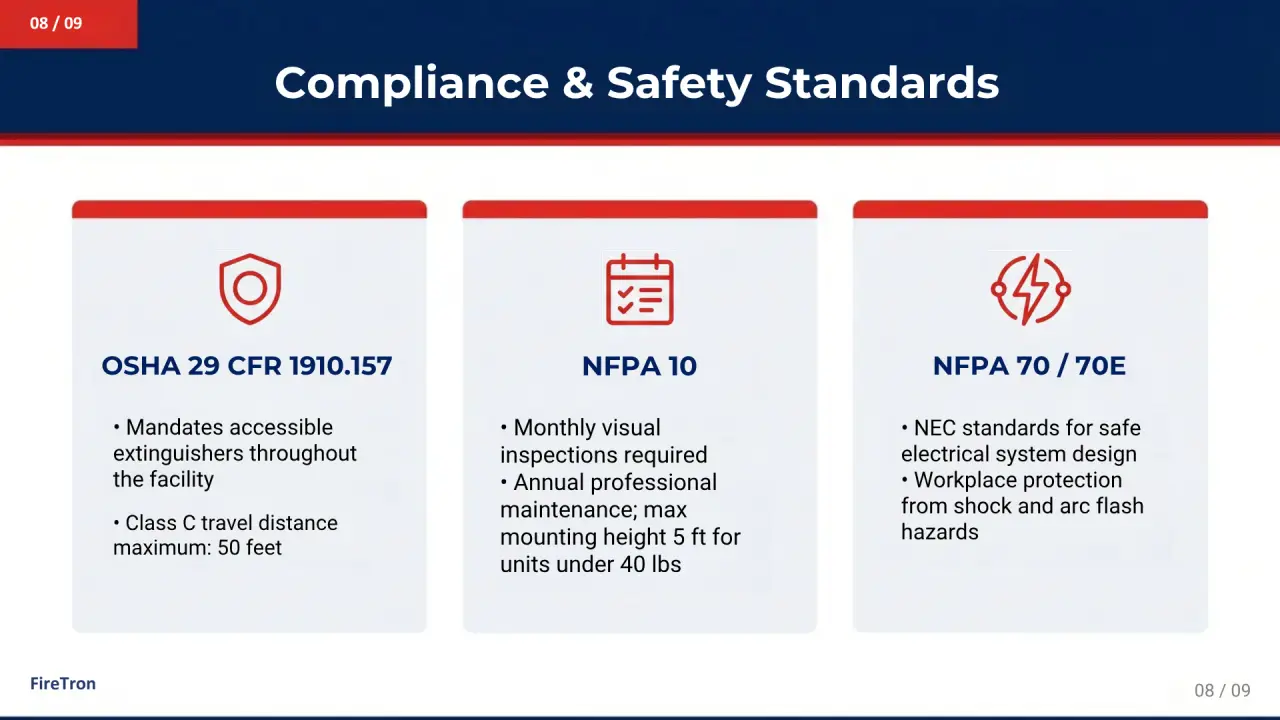
Maintaining compliance with federal and local safety standards is non-negotiable for business owners. Several key regulations dictate how electrical fire hazards must be managed.
- OSHA 29 CFR 1910.157: This Occupational Safety and Health Administration standard mandates that employers provide portable fire extinguishers and mount them so they are readily accessible. For Class C hazards, the travel distance to the nearest extinguisher is determined by the underlying Class A or Class B hazard, typically requiring an extinguisher within 50 feet of any point in the room.
- NFPA 10: The Standard for Portable Fire Extinguishers requires monthly visual inspections and annual professional maintenance. It also dictates mounting heights. Extinguishers weighing 40 pounds or less must be installed so the top is no more than 5 feet above the floor.
- NFPA 70 (NEC) and NFPA 70E: The National Electrical Code (NFPA 70) sets the benchmark for safe electrical design and installation to prevent fires from starting. Meanwhile, NFPA 70E provides guidelines for electrical safety in the workplace, protecting employees from shock and arc flash hazards.
Conclusion
Protecting your facility from electrical fires requires a strategic approach. When dealing with cables, switchgear, and IT equipment, clean agent fire extinguishers and CO2 extinguishers are the only acceptable portable solutions. Avoiding corrosive dry chemicals and conductive water-based agents will save your business from unnecessary downtime and catastrophic equipment loss.
At FireTron, we specialize in comprehensive fire protection services. Whether you need to source the correct Halotron extinguishers for your server room, schedule an annual inspection, or design a custom clean agent fire suppression system, our experts are ready to assist. Contact FireTron today to ensure your property is fully protected and compliant with all NFPA and OSHA standards.
References
- FireTron. “Best Fire Extinguishers for Electrical Fires, Server Rooms, and Data Centers.” FireTron.com. https://blog.firetron.com/fire-extinguishers/best-fire-extinguishers-electrical-fires/
- Koorsen Fire & Security. “CO2 Fire Extinguishers vs. Halotron Fire Extinguishers.” https://blog.koorsen.com/co2-fire-extinguishers-vs.-halotron-fire-extinguishers
- Impact Fire Services. “Carbon Dioxide Fire Extinguisher Guide.” https://resources.impactfireservices.com/carbon-dioxide-fire-extinguisher-guide
- US Made Supply. “Fire Extinguisher for Sensitive Electronics.” https://usmadesupply.com/resources/guides/fire-extinguisher-for-sensitive-electronics
- World Fire Blog. “The Top 10 Fire Extinguisher Types for Industrial Facilities in 2026.” https://www.worldfireblog.com/which-10-types-of-fire-extinguishers-must-every-industrial-facility-have-in-2026/
- National Fire Protection Association. “NFPA 75: Standard for the Fire Protection of Information Technology Equipment.” https://www.nfpa.org/product/nfpa-75-standard/p0075code/nfpa-75-standard-for-the-fire-protection-of-information-technology-equipment-2017/7517pdf
- US Made Supply. “Fire Suppression System Standards.” https://usmadesupply.com/resources/building-codes-standards/fire-suppression-standards
- Occupational Safety and Health Administration. “29 CFR 1910.157 – Portable Fire Extinguishers.” http://www.osha.gov/laws-regs/regulations/standardnumber/1910/1910.157
- US Made Supply. “OSHA 1910.157 vs NFPA 10.” https://usmadesupply.com/resources/building-codes-standards/safety-compliance/osha-1910-157
- National Fire Protection Association. “Understanding NFPA 70, National Electrical Code (NEC).” https://www.nfpa.org/education-and-research/electrical/understanding-nfpa-70-national-electrical-code