What Do Fire Extinguisher Services Cost?
A Comprehensive Guide for Facility Managers and Business Owners
Fire extinguishers serve as the critical first line of defense in commercial fire safety. Whether you manage a sprawling data center in Austin, a bustling restaurant in Dallas, or a large warehouse in Houston, ensuring that your fire extinguishers are fully operational is not just a best practice; it is a strict legal requirement. However, many property managers and business owners find themselves asking a common question: What do fire extinguisher services cost?
Budgeting for fire safety requires a clear understanding of the different types of services your equipment will need over its lifespan. From routine annual inspections to complex hydrostatic testing and emergency recharging, the costs can vary significantly based on the type of extinguisher, the size of your facility, and the specific regulatory codes you must meet. In this comprehensive guide, we will break down the average fire extinguisher inspection cost, the cost to recharge fire extinguishers, and the legal frameworks that dictate these necessary services.
The True Cost of Fire Extinguisher Services
Fire extinguisher maintenance is not a one-time expense. To remain compliant with the National Fire Protection Association (NFPA) 10 standard and Occupational Safety and Health Administration (OSHA) regulations, your equipment must undergo a series of scheduled services. Below is a detailed breakdown of what you can expect to pay for each type of service.
Annual Fire Extinguisher Inspection Costs
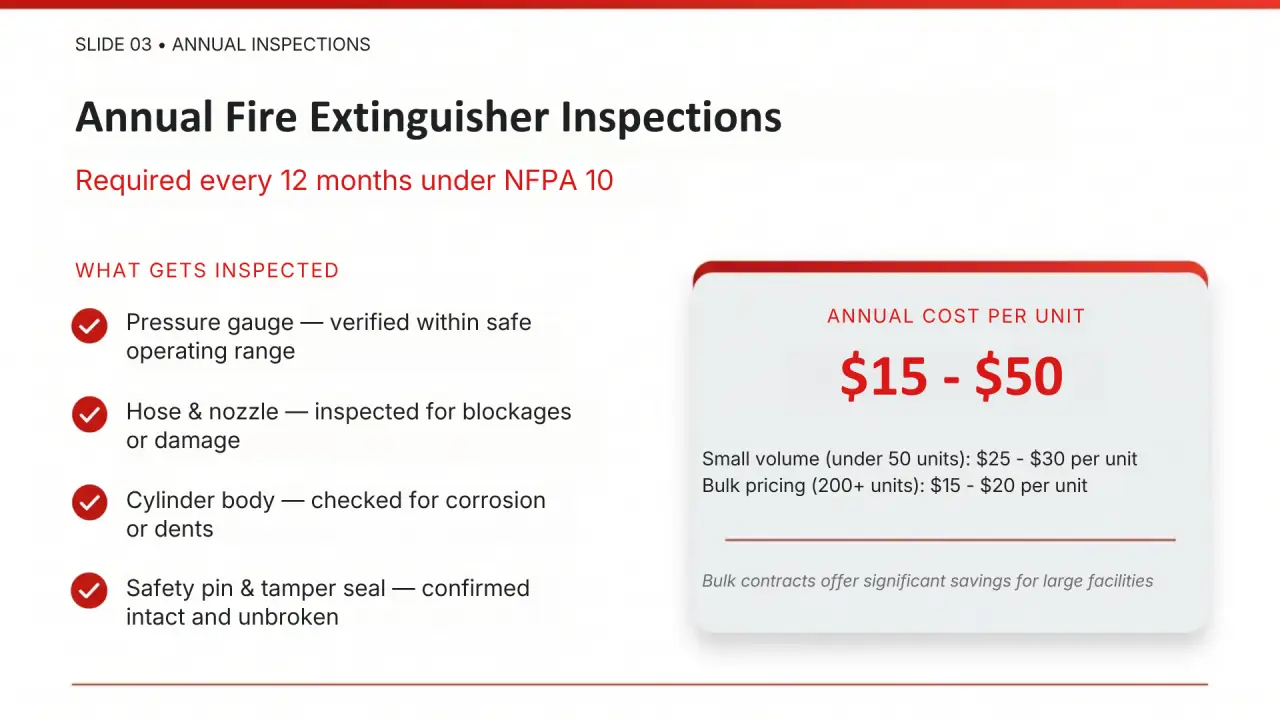
While facility staff are required to perform quick visual checks on a monthly basis, NFPA 10 mandates a thorough, professional inspection every 12 months. During this annual service, a certified technician will verify the pressure gauge, inspect the hose and nozzle for blockages, check the physical condition of the cylinder for corrosion, and ensure the safety pin and tamper seal are intact. Once completed, the technician will affix a new compliance tag.
In Texas, the average fire extinguisher inspection cost ranges from $15 to $50 per unit annually. The exact price often depends on the volume of extinguishers in your building. For example, a small retail store with 10 extinguishers might pay closer to $25 to $30 per unit, while a large industrial campus with over 200 units could see bulk pricing drop to $15 to $20 per unit.
6-Year Internal Maintenance Costs
Every six years, stored-pressure fire extinguishers (such as the common ABC dry chemical units) require a complete internal examination. This process involves discharging the extinguisher, dismantling the valve assembly, thoroughly cleaning the interior, replacing the O-rings and seals, and repressurizing the unit with the appropriate agent. This maintenance is crucial for preventing internal corrosion and powder caking, which can cause the extinguisher to fail during an emergency.
The cost for 6-year internal maintenance typically ranges from $35 to $80 per extinguisher. Because this service requires specialized equipment and complete depressurization, it is more labor-intensive than a standard annual inspection.
12-Year Hydrostatic Testing Costs
Hydrostatic testing is a rigorous procedure designed to verify the structural integrity of the extinguisher cylinder. Required every 12 years for dry chemical units (and every 5 years for Carbon Dioxide and water-based units), the cylinder is emptied, filled with water, and subjected to pressures exceeding its normal operating limits to check for leaks or weaknesses.
Hydrostatic testing generally costs between $50 and $150+ per unit [4]. It is important to note that for standard, inexpensive ABC dry chemical extinguishers, the cost of hydrostatic testing often approaches or exceeds the price of simply purchasing a brand-new unit. In these cases, your fire protection partner will likely recommend replacement. However, for expensive specialty units like Clean Agent or large wheeled extinguishers, hydrostatic testing remains highly cost-effective.
Cost to Recharge Fire Extinguishers
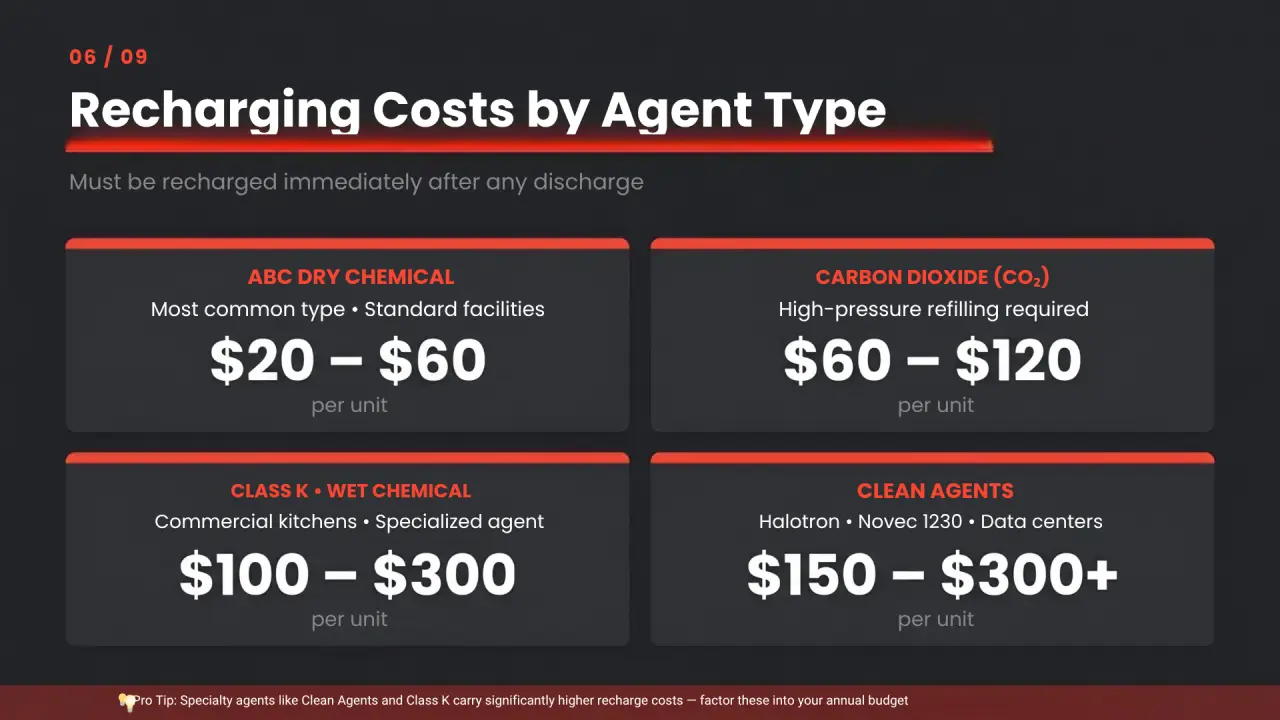
If a fire extinguisher is discharged for any reason, even for a brief second, it must be professionally recharged immediately. Recharging is also performed as part of the 6-year maintenance and 12-year hydrostatic testing processes. The cost to recharge fire extinguishers varies heavily based on the type of extinguishing agent required:
- ABC Dry Chemical: $20 to $60 per unit. This is the most common and least expensive agent to replace.
- Carbon Dioxide (CO2): $60 to $120 per unit. CO2 requires high-pressure refilling equipment.
- Class K (Wet Chemical): $100 to $300 per unit. Used in commercial kitchens, this specialized liquid agent is more costly to source and handle.
- Clean Agents (Halotron, Novec 1230): $150 to $300+ per unit. Clean agents leave no residue and are safe for sensitive electronics, making them ideal for server rooms and data centers. The chemicals themselves are highly specialized and expensive.
Factors That Influence Fire Extinguisher Pricing
When requesting a quote for fire extinguisher services, several variables will impact your final bill:
- Economies of Scale: Service providers incur costs just to dispatch a technician to your location. If you only have two extinguishers, your per-unit cost will be higher to cover the trip charge. Facilities with dozens of units benefit from significant volume discounts.
- Type of Extinguishers: Standard ABC dry chemical units are straightforward to service. Conversely, specialized units like Class K kitchen extinguishers, non-magnetic MRI-safe units, or Clean Agent systems require specific training, tools, and expensive refill agents.
- Emergency vs. Scheduled Service: If you discharge an extinguisher putting out a small fire and need an emergency, same-day recharge to reopen your business, expect to pay premium rates (often $100 to $150+ for an after-hours response). Scheduled, routine maintenance is always the most budget-friendly approach.
- Bundled Services: Many property managers save money by bundling their fire extinguisher inspections with other life safety services, such as fire alarm testing, sprinkler system inspections, and kitchen hood suppression maintenance.
Legal Requirements and Compliance Standards
Understanding the costs of fire extinguisher services is only half the equation; understanding why these services are mandatory is equally important. Fire safety compliance is heavily regulated at both the federal and state levels.
OSHA Regulations
The Occupational Safety and Health Administration (OSHA) enforces workplace safety under federal law. Specifically, 29 CFR 1910.157 dictates the placement, use, maintenance, and testing of portable fire extinguishers provided for employee use. OSHA requires employers to ensure that extinguishers are fully charged, in their designated places, and visually inspected monthly. Failure to maintain this equipment can result in severe penalties.
Following the annual inflation adjustments for 2026, the maximum OSHA penalty for a single “Serious” violation is $16,550. For “Willful or Repeated” violations, fines can skyrocket to an astonishing $165,514 per violation. When you compare a potential $16,550 fine to a $30 annual inspection fee, the return on investment for proper maintenance is undeniable.
NFPA 10 and State Fire Codes
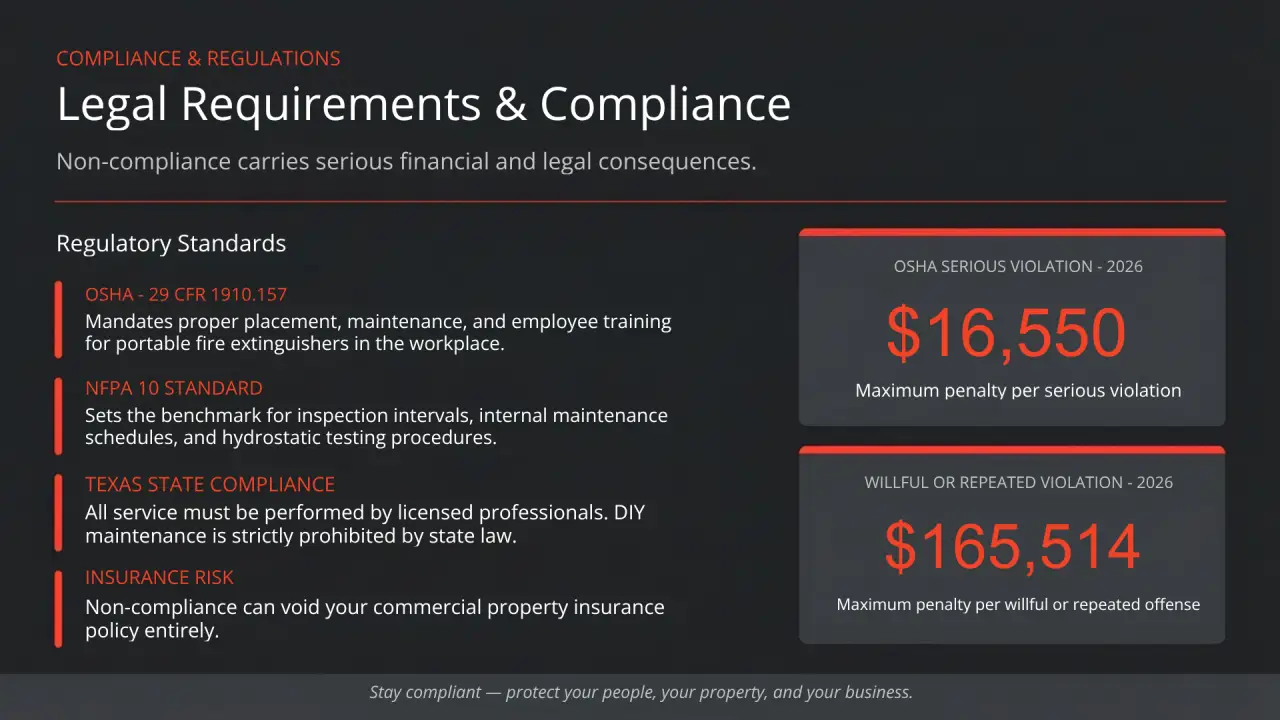
While OSHA sets the federal workplace rules, the technical standards for exactly how to inspect and maintain extinguishers are established by the NFPA. NFPA 10: Standard for Portable Fire Extinguishers is the benchmark document adopted by most local jurisdictions, including the Texas State Fire Marshal. NFPA 10 outlines the strict intervals for annual inspections, 6-year teardowns, and hydrostatic testing. In Texas, these services must be performed by licensed and certified fire protection professionals; DIY maintenance is strictly prohibited and non-compliant.
Frequently Asked Questions (FAQ)
How much does a fire extinguisher inspection cost?
In Texas, a standard annual professional fire extinguisher inspection typically costs between $25 and $50 per unit. Prices may be lower per unit if you have a large facility with many extinguishers, as service providers often offer volume discounts.
Is it cheaper to recharge or replace a fire extinguisher?
It depends on the age, type, and condition of the extinguisher. For a standard 5 lb or 10 lb ABC dry chemical extinguisher, recharging ($20 to $60) is usually cheaper than buying a new commercial-grade unit ($60 to $130). However, if the unit is due for its 12-year hydrostatic test, the cost of testing and recharging combined may exceed the cost of a new unit, making replacement the smarter financial choice.
How often do fire extinguishers need to be checked?
According to NFPA 10, fire extinguishers require a quick visual inspection by your staff every month. They require a comprehensive inspection by a certified professional once a year. Additionally, they require internal maintenance every 6 years and hydrostatic pressure testing every 5 or 12 years, depending on the cylinder type.
Can I get fined for expired fire extinguisher tags?
Yes. Missing, expired, or unpunched inspection tags are clear violations of both local fire codes and OSHA regulations. Local Fire Marshals can issue citations and fines, and OSHA can levy penalties up to $16,550 for serious safety violations. Furthermore, non-compliant extinguishers can void your commercial property insurance in the event of a fire.
What is a Clean Agent fire extinguisher, and why does it cost more to service?
Clean Agent extinguishers (like Halotron or Novec 1230) use specialized gases that extinguish fires without leaving a corrosive residue. They are essential for protecting sensitive electronics in server rooms and data centers. They cost more to service ($150 to $300+ for a recharge) because the chemical agents themselves are highly specialized, environmentally regulated, and expensive to manufacture compared to basic dry chemical powders.
Need Reliable Fire Extinguisher Services in Texas?
Don’t leave your facility’s safety to chance. FireTron provides code-compliant inspections, recharging, and maintenance across Houston, Austin, Dallas, and beyond.
Contact FireTron Today for a Free Estimate