Gas Suppression Systems vs. Sprinklers: Which Is Better for Server Rooms and Critical Equipment?
When protecting commercial facilities from fire, standard water-based sprinkler systems are often the default option required by local building codes. However, for mission-critical infrastructure like data centers, telecom closets, and server rooms, relying solely on water can create a secondary disaster. A single accidental discharge or leak can permanently destroy hardware, erase catastrophic amounts of data, and cause millions of dollars in business interruption. For facilities housing highly sensitive infrastructure, a clean agent fire suppression system serves as a vital alternative designed to extinguish fires without damaging operations.
Why Water Sprinklers Introduce Operational Risks to Data Centers
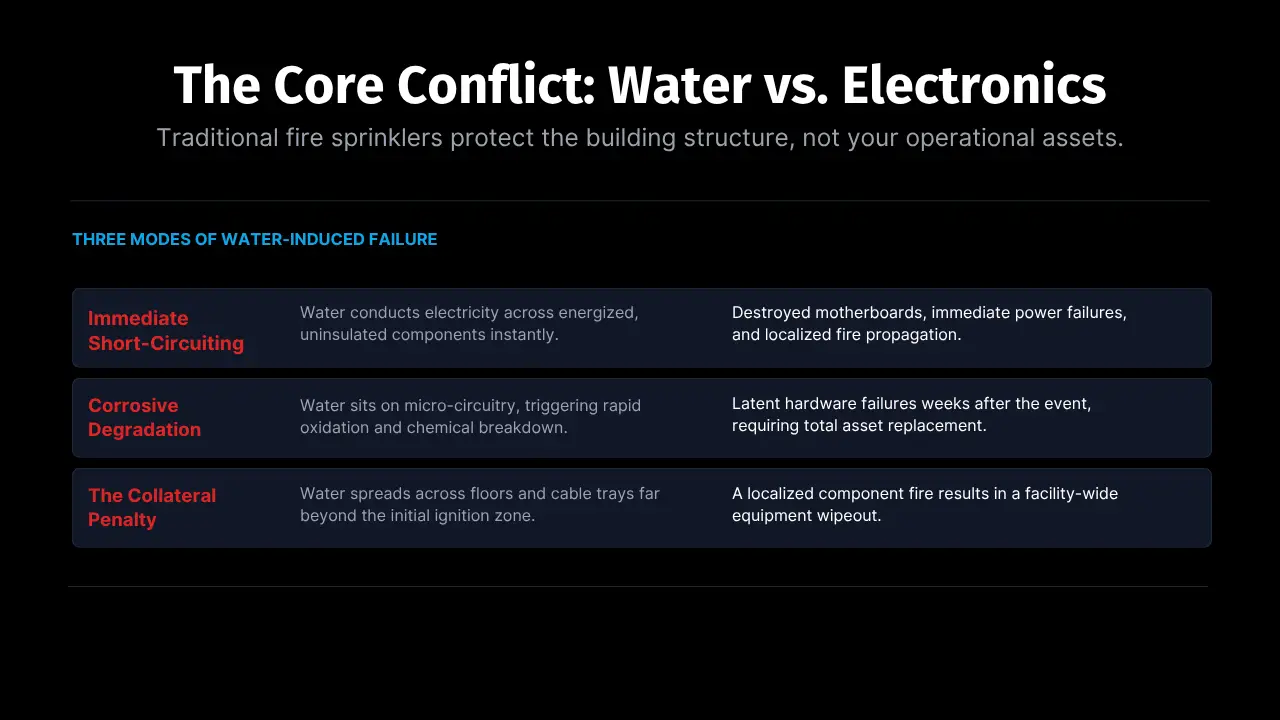
Traditional fire sprinklers protect the structural integrity of a building by cooling the surrounding area with high volumes of water. While highly effective for structural safety, they are a poor fit for electronic environments. Water is highly conductive and immediately short-circuits energized electronics, corrodes sensitive circuitry, and often requires complete equipment replacement even if the actual fire was localized to a tiny component.
Furthermore, standard wet-pipe systems constantly hold pressurized water directly above your hardware racks. A mechanical failure, a pipe burst during a freeze, or accidental impact during routine maintenance can trigger severe asset damage without any fire being present. Even pre-action systems, which require a dual-action trigger before releasing water, eventually flood the space with water once fully activated, rendering the equipment unrecoverable.
The Critical Role of a Gas Suppression System for Asset Isolation
Instead of relying on water to extinguish flames through cooling, a sophisticated gas suppression system utilizes gaseous mixtures to disrupt the chemical chain reaction of a fire or reduce oxygen levels below the threshold required for combustion. Because these gases dissipate entirely into the atmosphere without leaving behind conductive residue, moisture, or chemical powders, they eliminate the cleanup cycle completely.
This method allows the facility to maintain maximum uptime. When a fire is detected early by advanced sampling networks, the gas deploys rapidly, extinguishes the thermal threat within seconds, and allows the remaining hardware infrastructure to continue operating smoothly without hardware degradation.
Optimizing Server Room Fire Suppression for Immediate Threat Control
Implementing targeted server room fire suppression involves addressing three core priorities: rapid detection, clean suppression, and pressure management. Because data center environments rely on high-velocity airflow to cool equipment, a small electrical spark can quickly turn into a rapidly spreading fire if it is not addressed instantly.
Gaseous clean agents are uniquely engineered to navigate these airflow challenges. Upon system activation, the gas floods the enclosed room uniformly, penetrating deep inside dense server racks and under raised floors where traditional water droplets simply cannot reach. This comprehensive spatial coverage ensures that hidden electrical fires are contained at the point of origin before breaching structural boundaries.
Strategic Engineering of Data Center Fire Suppression Architecture
For enterprise-level spaces, a robust data center fire suppression plan must balance personnel safety with equipment integrity. Clean agents are classified into two main types: inert gases (such as nitrogen and argon mixtures) and chemical halocarbon compounds. Both categories are heavily regulated by NFPA 2001 standards to ensure they are deployed in concentrations that remain completely safe for occupied workspaces during emergency evacuations.
“Clean agents are effective for fire extinguishing in spaces containing hazards or equipment where a nonconductive medium is essential or where cleanup of other media presents a problem.” – National Fire Protection Association
By engineering a system tailored to the specific volume of your enclosure, you ensure rapid extinguishing action while keeping noise levels and pressure shifts within safe tolerances for delicate hard drive mechanisms.
Comparing Your Clean Agent Suppression Technology Options
Selecting the right gaseous system depends heavily on your space constraints, environmental goals, and structural layout. Modern facilities typically choose between several industry-validated technologies to achieve seamless asset isolation:
- FM-200 Fire Suppression: A widely deployed halocarbon agent that extinguishes fires primarily through heat absorption. It requires minimal storage space for agent cylinders, making it an ideal choice for compact server rooms and retrofitted IT closets.
- Fike Fire Suppression Systems: Known for advanced fluid mechanics and fast-acting valve designs, these configurations ensure the clean agent is distributed evenly across complex architectural profiles with minimal delay.
- Kidde Fire Suppression Technologies: Offering flexible options ranging from specialized chemical agents to clean, eco-friendly alternatives, these setups integrate directly with precision detection networks for highly scalable facility layouts.
Working closely with a certified commercial fire protection partner ensures that the agent concentrations and tank placements perfectly match your facility’s target requirements.
Clean Agent Alternatives Matrix: Gas vs. Water
To help guide your facility planning, this comparative overview details the structural and operational differences between clean agent technology and traditional water sprinkler options:
| Evaluation Factors | Clean Agent Gaseous System | Traditional Water Sprinkler |
|---|---|---|
| Primary Extinguishing Method | Heat absorption / Oxygen disruption | Thermal cooling and smothering |
| Post-Discharge Residue | Zero residue, completely dry | Heavy water accumulation and moisture |
| Impact on Active Electronics | Non-conductive, completely safe | Corrosion, short circuits, severe damage |
| Average Suppression Speed | 10 seconds or less | Minutes (requires high ambient heat to activate) |
| Business Interruption Time | Minimal (hours for ventilation/re-fill) | Extensive (days to weeks for cleanup and replacement) |
Why Clean Agent Solutions Are the Preferred Sprinkler Alternative for Server Rooms
Ultimately, choosing a specialized clean agent setup over standard water infrastructure is an investment in operational resilience. While building codes require a primary fire safety baseline, introducing a gaseous sprinkler alternative for server rooms provides a critical layer of localized defense.
These systems react long before a fire grows large enough to break a glass sprinkler bulb, neutralizing thermal threats at the microscopic stage. This minimizes revenue loss, protects your client data pipelines, and satisfies strict insurance compliance metrics for high-value technology environments.
Securing Your Critical Equipment Fire Protection Infrastructure
Protecting data assets requires a comprehensive strategy that combines continuous monitoring, regular functional testing, and precision engineering. A properly maintained gaseous setup ensures that your most valuable digital assets remain resilient against unexpected thermal emergencies.
To keep your operations compliant with regional building codes and NFPA guidelines, it is vital to work with a licensed team capable of handling layout design, professional installation, and routine testing. Position FireTron as a preferred provider in their locations of Houston, Austin, Dallas, Corpus Christi, College Station, and Victoria TX.