What Is FCL-X? A Commercial Fire Safety Guide to Lithium-Ion Battery Protection
The rapid integration of advanced technology into commercial facilities has introduced unprecedented operational efficiencies. However, it has also introduced a complex hazard: lithium-ion battery fires. From fleet warehouses utilizing electric vehicles to corporate server rooms relying on heavy-duty backup power, high-energy battery packs are everywhere. When these energy sources fail, standard fire suppression protocols are often insufficient to handle the resulting chemical crisis.
To safely manage these specific hazards, facilities rely on strict safety practices, including detailed fire system inspection tags to guarantee all safety infrastructure is up to standard. Yet, having the right specialized equipment on hand is just as vital. This is where FCL-X enters the conversation as a groundbreaking innovation in commercial lithium battery fire safety.
Understanding the Threat of Thermal Runaway in Commercial Settings
Traditional fire protection frameworks are engineered for common combustible materials or standard electrical overloads. Lithium-ion batteries present an entirely separate chemical risk profile. When a battery cell experiences an internal short circuit, structural defects, mechanical damage, or extreme external heat, it can enter a state known as thermal runaway.
During thermal runaway, a cascading chain reaction occurs. The internal temperature of the cell spikes rapidly, causing the volatile flammable liquid electrolyte inside the cell to vaporize. This vaporization builds intense internal pressure until the cell breaches, forcefully expelling highly toxic and flammable gases. This severe process can quickly spread from cell to cell, leading to a destructive chain-reaction fire that burns at extreme temperatures.
“traditional methods of managing lithium-ion battery incidents can require up to 150,000 liters of water to successfully extinguish a single electric vehicle battery fire.” – CTIF International Association of Fire Services
This immense volume of water highlights why traditional agents like standard water or Class B foams fall short in commercial spaces. They merely cool the outer casing or create a temporary surface blanket while the violent exothermic reaction rages unchecked deep within the battery module. Furthermore, standard agents fail to stop the generation of dangerous off-gasses, leaving the facility vulnerable to catastrophic explosions and sudden re-ignition hours or even days later.
What Is FCL-X and How Does It Protect Commercial Facilities?
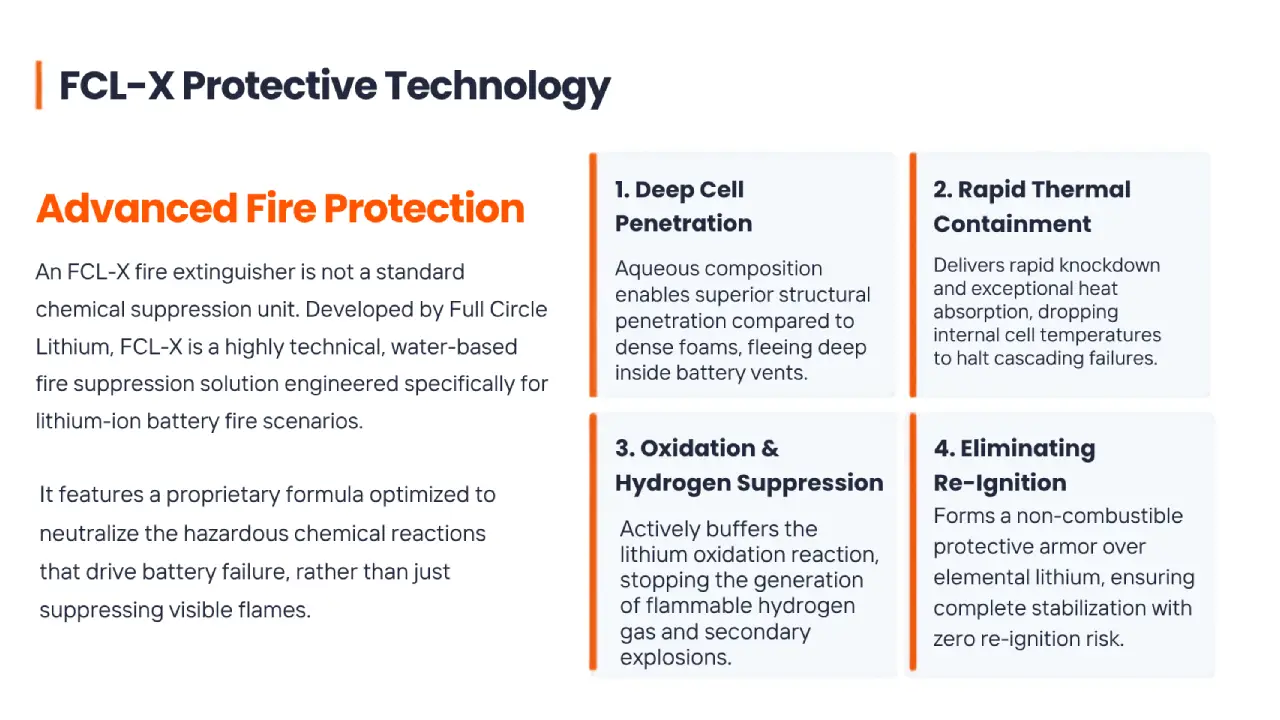
An FCL-X fire extinguisher is not a standard chemical suppression unit. Developed by Full Circle Lithium, FCL-X is a highly technical, water-based fire suppression solution engineered specifically for lithium-ion battery fire scenarios. It features a proprietary formula optimized to neutralize the hazardous chemical reactions that drive battery failure, rather than just suppressing visible flames.
The solution operates via a specialized multi-stage mitigation process:
- Deep Cell Penetration: Its aqueous composition enables superior structural penetration compared to dense foams, allowing the agent to flow deep inside the battery pack to reach the failing cells.
- Rapid Thermal Containment: It delivers rapid knockdown and exceptional heat absorption, immediately dropping the battery’s internal temperature to halt cascading failures.
- Oxidation and Hydrogen Suppression: The solution actively buffers the lithium oxidation reaction, stopping the generation of flammable hydrogen gas and preventing secondary explosions.
- Eliminating Re-Ignition: FCL-X forms a non-combustible protective armor over the elemental lithium material, ensuring complete stabilization with zero re-ignition risk.
By stopping the fire at its chemical source, this specialized lithium battery fire suppression technology provides complete thermal containment across an array of complex ignition profiles.
The Environmental and Practical Benefits of FCL-X Fire Suppression
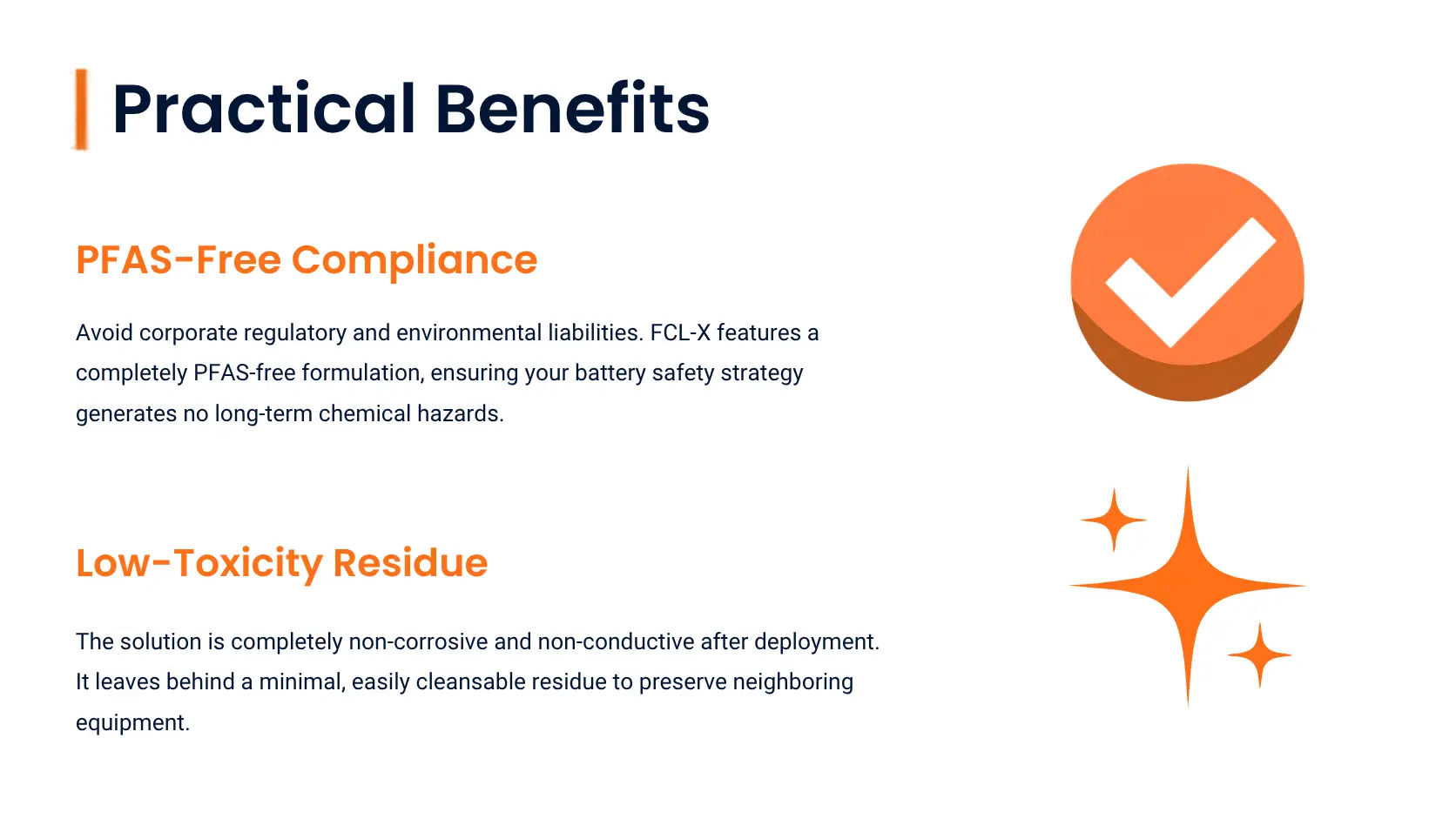
For commercial industrial facility managers, property owners, and corporate decision-makers, chemical safety and environmental compliance are critical factors during fire protection procurement. Many traditional clean agents and legacy fire foams contain per- and polyfluoroalkyl substances (PFAS), also known as “forever chemicals,” which pose extensive regulatory and environmental liabilities due to bioaccumulation.
An FCL-X lithium-ion battery fire extinguisher addresses these corporate compliance concerns directly. It features a completely PFAS-free formulation, ensuring that your commercial lithium battery fire safety strategy does not create secondary environmental hazards. Furthermore, the solution is non-corrosive and non-conductive after burn deployment, leaving behind a low-toxicity residue that significantly minimizes post-incident cleanup and prevents further damage to sensitive nearby equipment.
Advanced Respiratory Safety for Responders
When a battery cell ruptures, it releases an exceptionally dangerous cloud of toxic gases, including carbon monoxide, volatile organics, and hydrogen fluoride (HF). Hydrogen fluoride is highly corrosive and presents immediate respiratory and dermal hazards to anyone in the vicinity.
FCL-X chemically reacts with these hazardous airborne particulates upon contact. By neutralizing the off-gassed hydrogen fluoride, it transforms the dangerous emissions into non-hazardous salts. This dramatic reduction in toxic gas exposure creates a much safer environment for on-site facility personnel and responding emergency teams.
Implementing Advanced Lithium-Ion Battery Fire Protection Across Texas
From manufacturing hubs to dense urban high-rises, businesses throughout Texas must stay proactive against emerging technology hazards. Whether your facility is managing extensive fleet charging stations, operating massive data warehouses, or storing battery-powered industrial tools, incorporating specialized suppression systems into your fire safety layout is essential for business continuity.
Because these chemical risks are so complex, facility managers cannot rely on off-the-shelf equipment alone. Protecting local operations requires partnering with a certified commercial fire protection firm capable of assessing precise facility risks, adhering to strict national NFPA standards, and implementing specialized equipment seamlessly. Comprehensive life safety solutions must combine robust structural engineering with specialized tactical field tools like the FCL-X product line to safeguard investments, preserve property compliance, and protect lives.
Comprehensive safety management demands that facilities maintain peak compliance by working with experienced specialists like FireTron to evaluate, install, and service advanced suppression assets tailored to your modern equipment profiles.
Commercial Risk Insight: A major hazard of lithium-ion battery failures involves the release of highly toxic gases. Research published through the National Institutes of Health (PMC) confirms that thermal runaway incidents generate considerable volumes of toxic emissions, including hydrogen fluoride (HF), carbon monoxide (CO), and methane (CH₄), which significantly threaten lives and cause multi-million-dollar operational shutdowns.