Fire Suppression System Cost Guide
Commercial properties in Texas face unique fire safety challenges due to high temperatures, large facilities, and varied industries. From fire suppression system installations in Houston schools to a top-rated fire suppression system like Pyro-Chem FM200 units in Austin server rooms, the right system can mean the difference between minor damage and total loss.
However, if you manage a commercial kitchen, paint booth, server room, or food truck in Texas, one question comes up before almost every other decision: how much does a fire suppression system cost? The honest answer is “it depends,” but that is not very useful when you are trying to build a budget.
Our fire suppression cost guide breaks the fire suppression system price down by system type, square footage, and installation complexity, using ranges typical of projects across Houston, Austin, Dallas-Fort Worth, Corpus Christi, College Station, and Victoria.
Whether you are pricing out a wet chemical kitchen hood system, a clean agent setup for a data center, or a compact unit for a mobile food truck, you will find the numbers and the reasoning behind them below.
Quick Summary Guide
Fire Suppression System Cost at a Glance
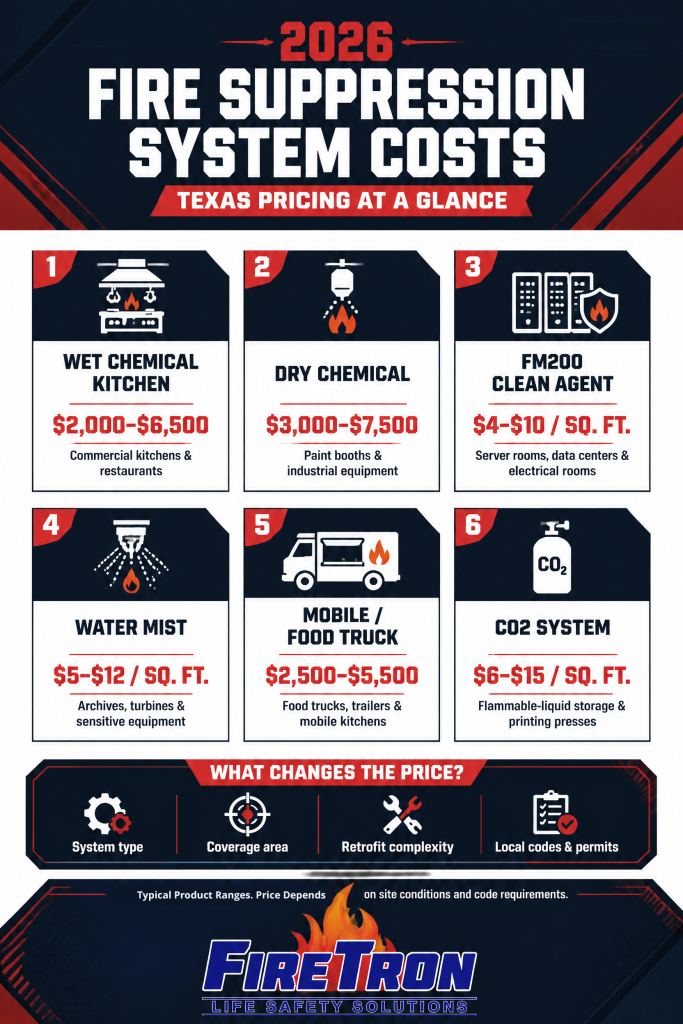
Before getting into the details, here is a quick snapshot of what most Texas businesses pay for a fire suppression system, from equipment only, up through full installation.
| System Type | Average Price Range | Typical Use Case |
|---|---|---|
| Wet Chemical Kitchen System | $2,000 – $6,500 | Commercial kitchens, restaurants |
| Dry Chemical System | $3,000 – $7,500 | Paint booths, industrial equipment |
| Clean Agent (FM200) System | $4 – $10 per sq. ft. | Server rooms, data centers, electrical rooms |
| Water Mist System | $5 – $12 per sq. ft. | Turbine enclosures, archives, sensitive equipment |
| Mobile / Food Truck System | $2,500 – $5,500 | Food trucks, trailers, mobile kitchens |
| CO2 System | $6 – $15 per sq. ft. | Flammable liquid storage, printing presses |
These are starting points. Your actual fire suppression system price depends on square footage, building layout, local code requirements, and whether you are installing new or retrofitting.
How Fire Suppression System Pricing Works
Every quote is built from the same handful of variables. Understanding them helps you compare bids and spot a quote that is missing something.
System Type
The suppression agent itself (water, wet chemical, dry chemical, clean agent gas, or water mist) drives most of the cost difference. Clean agent and water mist systems use more expensive hardware and agent, so they cost more per square foot than a standard kitchen hood system.
Square Footage and Coverage Area
Larger spaces need more detection points, piping, and nozzles. For this reason, pricing for whole-room systems (like FM200 or water mist) is almost always quoted per square foot.
Building Use and Risk Level
A commercial kitchen, a paint booth, and a server room all carry different fire risks, and codes reflect that. Higher-risk occupancies require more robust detection and faster suppression, which raises the price.
New Construction vs. Retrofit
Installing a system during new construction is cheaper because piping and wiring are put in before walls and ceilings are finished. Retrofitting an existing building often means opening walls, rerouting conduit, and working around existing equipment, which adds labor cost.
Local Codes and Permits
Texas cities and counties do not all enforce the same fire codes. Houston, Austin, and Dallas each have their own permitting and inspection requirements, and system design has to account for the Authority Having Jurisdiction (AHJ) in your area.
Fire Suppression System Cost by Type
Wet Chemical Kitchen Hood Systems
Wet chemical systems are the standard for commercial kitchens and restaurants. They are designed to suppress grease fires in hoods, ducts, and cooking equipment, and most jurisdictions require them under NFPA 96.
Typical cost: $2,000 to $6,500, depending on the number of hood sections, appliances protected, and whether ductwork needs modification. A single-hood kitchen in a strip-mall restaurant sits at the low end. A large kitchen with multiple hood runs, common in hotels, hospitals, and school cafeterias, can push toward the higher end or beyond.
Dry Chemical Paint Booth Systems
Industrial paint booths and mixing rooms use dry chemical systems because they handle flammable liquid and vapor fires that water-based systems cannot suppress effectively.
Typical cost: $3,000 to $7,500. Pricing depends on booth size, the number of nozzles required for full coverage, and whether the system needs to tie into existing exhaust fan shutdowns and makeup air controls.
Clean Agent Systems (FM200 and Similar)
Clean agent systems like FM200 protect server rooms, data centers, and electrical rooms where water damage would be as costly as the fire itself. The agent suppresses fire without leaving residue, so equipment stays protected.
Typical cost: $4 to $10 per square foot, including tanks, piping, nozzles, and detection. A small 300 to 500 sq. ft. server room typically lands between $2,500 and $5,000 installed. Larger data halls scale up from there.
Water Mist Systems
Water mist systems use a fine spray to cool and suppress fire with far less water than a traditional sprinkler system, which makes them a good fit for archives, museums, turbine enclosures, and spaces with sensitive equipment.
Typical cost: $5 to $12 per square foot. The higher cost per square foot compared to wet chemical systems reflects the pump packages, high-pressure piping, and specialized nozzles these systems require.
CO2 Systems
CO2 suppression systems are used less often today because of the asphyxiation risk in occupied spaces, but they still show up in flammable liquid storage, printing operations, and some industrial applications where clean agent alternatives are not practical.
Typical cost: $6 to $15 per square foot, largely because of the CO2 storage cylinders and the additional safety controls (pre-discharge alarms, abort switches) required for occupied areas.
Fire Suppression Systems for Food Trucks and Mobile Kitchens
Mobile kitchens need a compact wet chemical system sized to their cooking equipment, and most health departments and fire marshals require proof of a working system before issuing a permit.
Typical cost: $2,500 to $5,500, depending on the number of appliances and whether the truck needs a custom hood built to fit.
Fire Suppression System Cost Per Square Foot
For whole-space systems, pricing per square foot is the easiest way to compare quotes across vendors. Here is how the major system types stack up.
| System Type | Cost per Sq. Ft. |
|---|---|
| FM200 Clean Agent | $4 – $10 |
| Water Mist | $5 – $12 |
| Novec 1230 | $6 – $12 |
| CO2 | $6 – $15 |
Note: wet chemical kitchen and dry chemical paint booth systems are almost always quoted as a flat project price rather than per square foot, since they are sized to specific equipment (hoods, spray booths) rather than an entire room.
What Is Included in Installation Cost
A fire suppression system quote should break down into three categories. If a bid only gives you one number, ask for the breakdown. It is the easiest way to catch a lowball quote that is missing scope.
Equipment
Tanks, agent, detection devices, control panels, piping, and nozzles. This is usually 40 to 60 percent of the total project cost.
Labor
Installation, electrical tie-ins, and integration with your existing fire alarm system. Labor cost rises with retrofit complexity and building access constraints.
Permits and Inspection
Design review, permit fees, and the final inspection and certification required before the system can be put into service. Costs vary by city, but budget $200 to $800 for permitting on most commercial projects.
Real-World Cost Examples
These scenarios reflect typical Texas projects and give you a sense of where your own budget might land.
500 Sq. Ft. Server Room in Houston
A mid-sized IT room using an FM200 clean agent system typically runs $2,500 to $4,500 installed, including detection, tanks, and piping sized for the room’s ceiling height.
Mid-Sized Paint Booth in Austin
A dry chemical system for a single-bay spray booth generally costs $3,500 to $6,500, with the range driven by nozzle count and whether the exhaust fan interlock is part of the scope.
Full-Service Restaurant Kitchen in Dallas-Fort Worth
A multi-hood wet chemical system for a full-service restaurant kitchen typically falls between $3,500 and $6,500, and can run higher for kitchens with several hood sections or older ductwork that needs modification.
Food Truck in Corpus Christi
A compact wet chemical system sized for a standard four-burner range and fryer setup usually costs $2,800 to $4,800, including the custom-fit hood.
Ongoing Costs: Inspection, Maintenance, and Recharge
The purchase price is only part of the picture. NFPA standards require most fire suppression systems to be inspected semi-annually, and Texas fire marshals enforce this closely for commercial kitchens in particular.
Budget for:
- Semi-annual inspections: $150 to $400 per visit, depending on system type and location
- Agent recharge after a discharge: $500 to $2,500, depending on system type and tank size
- Component replacement (nozzles, detectors, control panels) as systems age
Skipping inspections does not just risk a fire going unsuppressed. It is also one of the most common reasons Texas businesses fail a fire marshal inspection or lose their occupancy permit.
Factors That Affect Your Fire Suppression System Price
- System type: clean agent and water mist systems cost more per square foot than wet or dry chemical systems.
- Square footage and ceiling height: larger and taller spaces need more piping, nozzles, and agent.
- Building use: high-risk occupancies like commercial kitchens and paint booths have stricter code requirements.
- New construction vs. retrofit: retrofits cost more due to demolition, patching, and working around existing infrastructure.
- Local codes and permits: Houston, Austin, Dallas, and other Texas cities each enforce their own permitting and inspection timelines.
- Integration requirements: tying the suppression system into an existing fire alarm or building management system adds engineering and labor time.
How to Choose the Right System for Your Budget
Price should not be the only factor, but it is usually the deciding one when two systems both meet code. A few starting points:
- If you are protecting cooking equipment, a wet chemical system sized correctly for NFPA 96 compliance is close to non-negotiable.
- If you are protecting electronics or irreplaceable assets, the higher per-square-foot cost of a clean agent or water mist system is usually worth it compared to potential losses.
- If you are working with a tight retrofit budget, ask your provider whether phased installation (protecting the highest-risk area first) is an option.
Getting quotes from a provider licensed for design, installation, and inspection in your specific market, not just a national installer working from a template, tends to produce more accurate first-time pricing, since local code knowledge avoids costly change orders mid-project.
Frequently Asked Questions
How much does a fire suppression system cost on average?
Most commercial fire suppression systems in Texas cost between $2,000 and $7,500 for kitchen, paint booth, and mobile systems, and $4 to $15 per square foot for whole-room systems like clean agent or water mist.
What is the cost per square foot for a fire suppression system?
Whole-room systems typically run $4 to $15 per square foot depending on the agent type, with clean agent (FM200) systems on the lower end and CO2 systems on the higher end.
How much does it cost to install a fire suppression system in a restaurant kitchen?
A wet chemical kitchen hood system for a full-service restaurant typically costs $2,000 to $6,500 installed, depending on the number of hoods and appliances covered.
Do food trucks need a fire suppression system, and how much does it cost?
Yes. Most Texas health departments and fire marshals require a working suppression system before issuing a mobile food unit permit. Budget $2,500 to $5,500 for a properly sized system.
What is included in fire suppression system installation cost?
Installation cost covers equipment (tanks, agent, detection, piping, nozzles), labor, and permitting and inspection fees. Equipment usually makes up 40 to 60 percent of the total.
Get a Fire Suppression System Quote in Texas
Every building is different, and the fastest way to get an accurate number is a site walkthrough with someone who knows your local code requirements. FireTron designs, installs, and services fire suppression systems across Houston, Austin, Dallas-Fort Worth, Corpus Christi, College Station, and Victoria.
Contact FireTron today for a free consultation and a fire suppression system quote built around your building, your equipment, and your budget.